"A new look at antique US railroad maps reveals how cities grew over the past 200 years. The FT's Alan Smith and Steven Bernard trace how cities, people and the economy spread from coast to coast"

"A new look at antique US railroad maps reveals how cities grew over the past 200 years. The FT's Alan Smith and Steven Bernard trace how cities, people and the economy spread from coast to coast"
"The combined impact of climate change, land mismanagement and unsustainable freshwater use has seen the world’s water-scarce regions increasingly degraded. This leaves their soils less able to support crops, livestock and wildlife. This week, the Intergovernmental Panel on Climate Change (IPCC) will publish its special report on climate change and land. The report, written by hundreds of scientists and researchers from across the world, dedicates one of its seven chapters solely to the issue of desertification."The 30 year climate map illustrates the geographies involved (plus see also Koppen climate maps)...
 In this light, it's worth inverting the issues and seeking opportunities in such drylands. The big technological achievements of the past half-century are solar power and desalination. But there's more, including much greater sophistication around water use, shades of greywater, cycling, and design and landscaping for water retention. Furthermore, reforestation, for instance in the Sahel, has been done with hardier plant varieties and is increasingly including soil modification or assistive techniques to both preserve water and make maximum use of every little bit. On arid but foggy coasts (e.g. Atacama, Namibia, etc) inexpensive materials are boosting the effectiveness of fog harvesting. And we can learn from classic desert cities and ancient techniques (e.g. Petra, the medinas, etc) about greening the desert. In any case, when you stitch all the existing and emergent ideas together, I believe there's a blossoming new category of "oasis cities" in arid regions.
"A growing chorus of economists and urbanists suggest that we may be seeing the “rise of the rest,” a result of both increasingly unaffordable housing in established hubs and the improvement of the economies in less-established hubs. [...] The map shows the percentage growth in the creative class from 2005 to 2017. A number of Rustbelt and Sunbelt metros which have previously lagged now show robust growth. Salt Lake City posted the fastest growth, with Pittsburgh and Cincinnati next in line. Las Vegas, which had the smallest creative class share of large metros in 2005, also saw significant growth. Of leading creative class metros, only Seattle and Baltimore registered comparable gains. [...] The even better news is that the creative class -- which often garners the highest paying jobs -- appears to be growing as a percentage of total workforce employment across the board."



"The Hawthorn Tower will, like its Milanese predecessor, be blanketed in greenery -- and it’s expected to absorb over 5.4 tons of carbon dioxide. The equivalent of one hectare of woods will be installed on the tower to create a real urban ecosystem with over 30 different vegetal species."


 These cluster into three big categories: Transformational Ventures, Creative Places, and Emergent Futures. Details below & online...
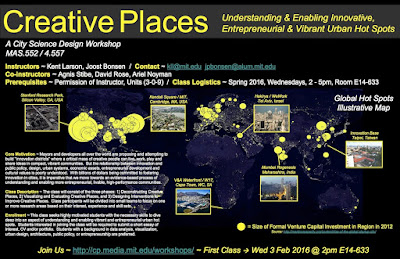 I'm co-teaching Creative Places class this Spring 2016 together with MIT Media Lab colleague Kent Larson and team, starting Wednesday, 3 February at 2pm, as part of our MIT Cities Initiative. We're particularly keen on understanding and enabling innovation, entrepreneurship, and creative vitality in cities. We seek better indices (or rankings or scores) and analyses especially of important but often intangible aspects of the city. Ultimately we aspire to deep understanding of how urban attractiveness can be best achieved through design, zoning, development, and more. Join us at first class Wed afternoon 2pm February 4th, 2016 in Media Lab E14-633.
"Beneath the crude statistic that the world is heading towards 70% urbanisation by 2050 lie regional differences in demographic, economic and environmental change. LSE Cities’ Urban Age programme takes a deeper look at the data"


.svg.png)


