"Here's something we all need to know. In China, when the spread of the virus is slow, we see a 1% death rate among those infected. When the spread of the virus is fast, hospitals get overloaded, ventilators become too scarce, and the death rate goes up to around 5%. (Italy, probably about a week or two ahead of the US in infections, is currently rationing medical equipment among the dying.) Note that the curve changes shape as people take more preventive measures, but the area under the curve remains more or less constant. About the same total number of people will be contracting the virus, but when that happens over a longer period of time you’re vastly more likely to get medical care if your situation becomes critical. Even with a slow growth rate, we're likely to lose 30 million people worldwide over the next two years. With a fast growth rate, that number could be 150 million."
Showing posts with label Disaster. Show all posts
Showing posts with label Disaster. Show all posts
10 March 2020
Flattening the Curve ~ Mitigating Covid-19....
David Reiley writes...

31 December 2018
Mega Tsunami Happen ~ Simulation of Past &...
Given the recent Indonesian disaster with Krakatoa Junior collapsing with consequent tsunami, it's worth looking at other examples of the same, including this simulation of Fogo in Cabo Verde several tens of thousands of years ago... And, of course, Krakatoa Senior some ~150 years ago was a whopper... But let's not stop there, here's the most likely thing (other than another Hurricane Sandy) to clobber the US Eastern Seaboard, La Palma in the Canarys going...
08 January 2018

12 August 2017
23 July 2016
Volcanic Climate Change ~ Sulfate Evidence...
OpenMind shares 1816, the Year Without a Summer when...

"It snowed and froze in parts of Europe and North America. Crops were ruined, triggering the worst famine of the nineteenth century [and] became known as “the year without a summer,” a climatic anomaly that affected the northern hemisphere"We now know this is at least partly due to the massive Tambora volcanic eruption.
"Evidence of the long range of the emissions from Tambora has been found in the high sulphur content in samples of polar ice from the time, says paleoclimatologist Robert Mulvaney of the British Antarctic Survey [...] “Very large eruptions (such as Tambora) can lift material very high in the atmosphere, and into the stratosphere,” explains Mulvaney. “Once in the stratosphere, the sulfur dioxide can oxidise into sulphuric acid, which is taken up by tiny water droplets to form a haze in the stratosphere that can reflect incident sunlight back away from the Earth, causing less light to penetrate through the atmosphere, and the Earth to cool.” This sulphuric acid circulating in the stratosphere is then detected in ice cores. In this way, scientists can estimate the volume of emissions from an eruption."Here's the evidence showing it's happened at huge scale at least a couple times per century, so inquiring minds want to know "when's next"?
13 July 2015
Cascadia Tsunami ~ Understanding Tectonic Risk
Kathryn Schulz writes in The New Yorker of The Really Big One...

"An earthquake will destroy a sizable portion of the coastal Northwest. The question is when. [...] At approximately nine o’ clock at night on January 26, 1700, a magnitude-9.0 earthquake struck the Pacific Northwest, causing sudden land subsidence, drowning coastal forests, and, out in the ocean, lifting up a wave half the length of a continent. It took roughly fifteen minutes for the Eastern half of that wave to strike the Northwest coast. It took ten hours for the other half to cross the ocean. [...] We now know that the Pacific Northwest has experienced forty-one subduction-zone earthquakes in the past ten thousand years. If you divide ten thousand by forty-one, you get two hundred and forty-three, which is Cascadia’s recurrence interval: the average amount of time that elapses between earthquakes. That timespan is dangerous both because it is too long -- long enough for us to unwittingly build an entire civilization on top of our continent’s worst fault line -- and because it is not long enough. Counting from the earthquake of 1700, we are now three hundred and fifteen years into a two-hundred-and-forty-three-year cycle."Here's a simulation of what happened back in 1700... And here's a geologist's discussion... Finally, documentary shock & awe imagery... NYTimes' DotEarthling Andrew Revkin weighs in too, with nice infographic showing past 8.0 and 9.0 events over 10K years...
26 December 2014
Tsunami 2004 ~ Recalling Boxing Day Disaster...
The Boxing Day 2004 earthquake and tsunami in the Indian Ocean -- ten years ago today, December 26th -- was one of the biggest natural disasters in modern memory, killing over a quarter-million people without (much) warning within 4-6 hours in at least a dozen countries -- and triggering unprecedented humanitarian relief efforts. There are several retrospective documentaries of note, but here's a sampling... For those interested in quantifying the catastrophe, first note this NOAA simulation of the tsunami wavefront... 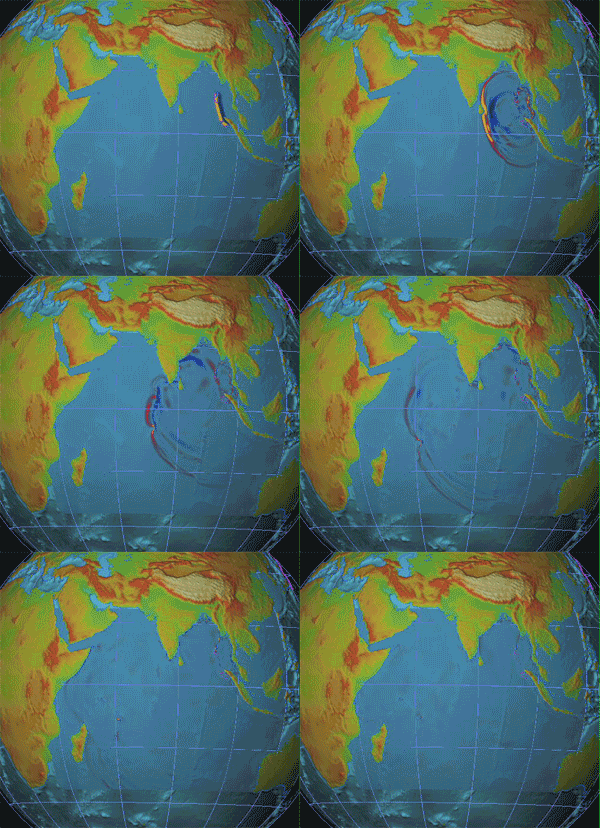 Second, look at this seismographic plot from around the world showing the Earth literally ringing from the rupture of the Sunda megathrust off the coast of Sumatra, Indonesia...
 We're learning ever more about quakes and tsunamis and NOAA's research and warning system is on the frontline... Nevertheless, the colossal power of plate tectonics is only one of the deadly natural perils mankind faces. Just one modest-sized asteroid hit, say like Eltanin or Chicxulub, would create quakes and tsunamis that make the Boxing Day disaster seem like ripples in a puddle. Simulate this for yourself via ImpactEarth! For civilizational survival, we need to figure out how to move humanity well beyond our cradle, ASAP.
Second, look at this seismographic plot from around the world showing the Earth literally ringing from the rupture of the Sunda megathrust off the coast of Sumatra, Indonesia...20 December 2014
Vestas Skipper Nico ~ Learning From Shipwreak...
At end November 2014, skipper Chris "Nico" Nicholson's nine-man Volvo Ocean Race team Vestas Wind ran their 65 foot racing yacht aground at 19 knots onto the charted Cargados Carajos Shoals, a reef nearish to Mauritius (which is roughly 200 nautical miles away) in the Indian Ocean. Thanks to gCaptain for sharing the saga and spotting his insights as shared with Sailing Anarchy's Alan Block... Here's some of the crash and context video... Vestas navigator Wouter comments on errors. Finally, some formal comments from CEO Frostad at Volvo Race Control...
02 November 2014
The Great Invisible ~ Disaster & Addiction to Oil
Thanks to the Scuttlefish for spotting trailer for The Great Invisible...
"Margaret Brown’s searing documentary [...] Rather than simply hurling oily muck at the perpetrators of the Deepwater Horizon disaster, this film promises a far more in-depth view of one of the worst environmental catastrophes in global history, its lingering effects, and the economic and human consequences of a global addiction to oil."
01 November 2014
On The Frontlines ~ NYC Property Flood Risk...
Thanks to Henry Melcher at ANblog for spotting new New York City Comptroller’s office policy brief On The Frontlines summarizing updated estimates of expected cost of property at risk from the next big Hurricane Sandy-class storm. Bottom line: ~US$130 Billion, over double previous estimates mostly due to expanded boundaries of expected damage, as visualized on maps... 
29 July 2014
R.I.P. Sheik Umar Khan ~ Sierra Leone Ebola Doc

25 July 2014
Carrington-class CME ~ Near-Miss Solar Storm...
A Carrington-class CME -- Coronal Mass Ejection or plasma burst -- narrowly missed Earth two years ago reports the Guardian's Maev Kennedy...
"The date of 23 July 2012 could have been the day the lights went out, along with suddenly not-so-smart phones, computers, satellite transmissions, GPS navigation systems, televisions, radio broadcasts, hospital equipment, electric pumps and water supplies. On that day an "extreme solar storm" did its best to end life on Earth as we know it. The sun forced out one of the biggest plasma clouds ever detected at a speed of 3,000km per second, more than four times faster than a typical solar eruption. Fortunately it missed. "If it had hit, we would still be picking up the pieces," said Daniel Baker, of the Laboratory for Atmospheric and Space Physics at the University of Colorado."Here's NASA's ScienceCast
05 June 2014
Macondo Blowout ~ Deepwater Disaster Anime
gCaptain spots the CSB's draft investigation report video anime of BP's Macondo well blowout and Deepwater Horizon disaster...
"The blowout preventer (BOP) that was intended to shut off the flow of high-pressure oil and gas from the Macondo well in the Gulf of Mexico during the disaster on the Deepwater Horizon drilling rig on April 20, 2010, failed to seal the well because drill pipe buckled for reasons the offshore drilling industry remains largely unaware of, according to a new two-volume draft investigation report released on June 5, 2014, by the U.S. Chemical Safety Board (CSB)."
19 April 2014
MIT Sustainability Summit 2014 ~ Coastal Cities
Check out student-run MIT Sustainability Summit 2014 with special focus on Coastal Cities this upcoming May 3rd and 4th...
"Half of the world population and three-quarters of all large cities are located on the coast. 634 million people are at risk from rising water levels. How will our world landscapes change as a result? From New York City to Shanghai, Sydney to Rio de Janeiro -- coastal cities have become the nexuses for today's global economy, yet face a confounding duality in which they are also the most threatened by climate change. MIT is addressing these challenges of coastal cities. [...] The conference will defy traditional notions of urban development to ask how coastal cities can sustain themselves and continue to grow as the climate changes and their local environments deteriorate."
25 March 2014
Beneath Cities ~ Decaying Infrastructure & Death
In NYTimes, Patrick McGeehan, Russ Buettner, and David Chen share scandal: Beneath Cities, a Decaying Tangle of Gas Pipes...

"It is a danger hidden beneath the streets of New York City, unseen and rarely noticed: 6,302 miles of pipes transporting natural gas. [...] The perilous state of New York City’s underground network, one of the oldest in the country [is] a glaring example of America’s crumbling infrastructure. [...] Communities across the country have been struggling to replace thousands of miles of these old, metal pipes with pipes made of plastic or specially coated steel that are less prone to leakage. Few, however, face as daunting a challenge as New York City. To replace all of the old mains in its network right now would cost as much as $10 billion, Con Edison estimates. Much of that expense would fall on the residents and businesses that use the gas for heating and cooking. [...] “Some of this aging infrastructure has reached the end of its useful life” [...] “It’s a major ordeal in a city like New York to just start digging things up.”Yikes, surely there's a better way to design, build, and maintain cities?! Here's the mess below as visualized by Larry Buchanan's infographic and Robert Stolarik's photos...
19 February 2014
Ronald McNair ~ StoryCorps on Astronaut Youth;-)
Upworthy's Adam Mordecai shares A Librarian Tried To Have A Genius Little Boy Arrested. The Cops Reacted The Same Way You Would...
"Ronald McNair grew up in Lake City, S.C. He grew up to [go to MIT and] become an astronaut. He was on the Challenger mission, which tragically exploded seconds after takeoff on Jan. 28, 1986. This is the actually funny story of how he started his journey in a time of great racial strife, as told by his brother to StoryCorps..."And here's library renaming news story... SC Hall of Fame show... Finally, The Spirit Lives On tribute video...
25 December 2013
Titanic Disaster ~ CGI Simulation of Sinking...
NatGeo shares Titanic: The Final Word With James Cameron who with his team craft CGI of how Titanic hit berg, took on water, and ultimately sank and hit the ocean floor... And here's NatGeo's Seconds from Disaster story...
19 August 2013
Disaster City Revisit ~ BBC Spots Training Hub
The BBC spotlights Disaster City which we've previously seen is an emergency worker learning lab...

"... the most comprehensive emergency response training facility in the world. At the 52 acre site, Saima Mohsin learns how full-scale reconstructions of collapsed buildings are used to simulate a wide variety of disaster scenarios, from explosions to train crashes and earthquakes. The findings are then usedto equip emergency personnel from across the world with the knowledge and technology to respond effectively in the most challenging situations."
22 July 2013
Into the Storm ~ Final Days of Tallship Bounty
 Mario Vittone at gCaptain shares his interactive timeline of Bounty’s last voyage before sinking at sea caught up in Superstorm Sandy...
 "Bounty should have never left New London. No one disagrees. But she did. What happened next -- at least what the surviving crew say happened next -- should be studied. There are lessons in the last voyage of Bounty for all of us. [This timeline] was created using the testimony of the surviving crew along with all other publicly available information on the sinking. It covers (primarily) the time Bounty left New London on October 25th until she sank on the morning of October 29th. Seeing it this way -- hour by hour as the trip unfolded -- provides a look into human nature and decision-making that we don’t get if we stay focused only on the mistake of making the trip at all. It shows how people -- even your people – might react in a crisis. It looks head-on into the normalizing of hazards and acceptance of risk with no gain. Watching the events unfold on Saturday, you can sense the crew’s tunnel vision and denial. And trying to figure out why it took so long to call for help may even infuriate some of you. It did me. Still, this is a wreck you want to look at."

11 May 2013
Al-Nakba ~ Palestinian Catastrophe on AlJaz...
AlJazeera shares Al-Nakba docu on Palestinian catastrophe...
Subscribe to:
Posts (Atom)


.svg.png)


