Showing posts with label Economy. Show all posts

08 December 2019

Circular Economies ~ From Trashflow to Cashflow

I've become increasingly intrigued by the circular economies idea wherein the classic linear material and energy flows going from source-to-sink are supplanted by recycling or reuse or waste-use material flow loops. Sarah Murray makes The case for a circular world in the recent FT Special Report on the Circular Economy...
"This is an approach to industrial and consumption systems that shifts from linear “take-make-dispose” models to circular ones that return what comes from nature to the production cycle. This means going back to the drawing board.  For example, Steelcase, the US office furniture maker, designs products with disassembly in mind. […] "we’re trying to, by design, keep things in the system as opposed to just reducing their negative impact,” […] For some companies, this has meant rethinking the business model. [Umcore made] the shift from mining operations to a business in refining, recycling and recovering speciality metals. […] DSM, a life sciences and materials sciences group [is] looking at how to recycle and reuse 100 per cent of carpets by making them from a single type of material, rather than from multiple materials. […] “People are frustrated by the extent of packaging and by having to throw a washing machine out after three years. Companies are responding —- that’s a big shift.”
In the WEF report Towards the circular economy: Accelerating the scale-up across global supply they spotlight -- and illustrate -- the material flows of a restorative industry system...
"First, a circular economy aims to design out waste. [...] Second, circularity introduces a strict differentiation between consumable and durable components of a product. [...] Third, the energy required to fuel this cycle should be renewable by nature."

22 December 2018

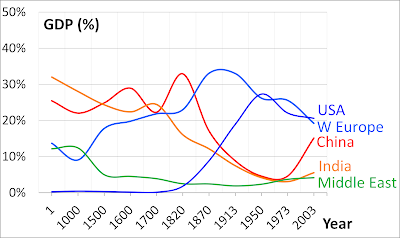
Longterm Lens ~ Maddison's Economic Stats...

Today I want to salute Angus Maddison who was a pioneer in macro economic history whose team investigated, gathered evidence for, and ultimately guesstimated national accounts over the longterm, including GDP and GDP/Capita... https://en.wikipedia.org/wiki/Angus_Maddisonhttps://en.wikipedia.org/wiki/Angus_Maddison

19 November 2018

China's American Dream ~ Growth Infographics!

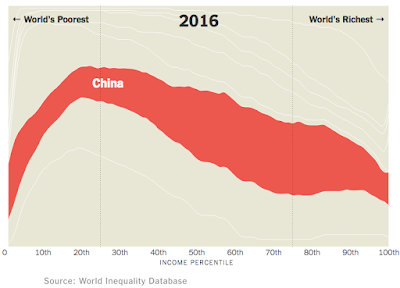
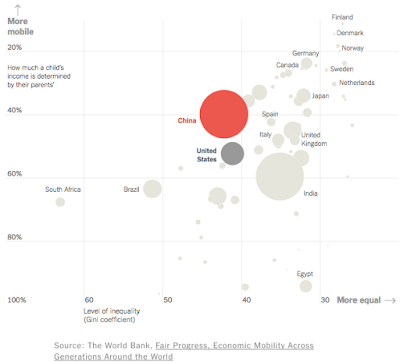
As part of the China Rules series, Javier Hernandez and Quoctrung Bui write in the NYTimes that The American Dream Is Alive. In China...
"In a country still haunted by the Cultural Revolution, where politics are tightly circumscribed by an authoritarian state, the Chinese are now among the most optimistic people in the world -- much more so than Americans and Europeans, according to public opinion surveys. What has changed? Most of all, an economic expansion without precedent in modern history. Eight hundred million people have risen out of poverty. That’s two and a half times the population of the United States. [...] China used to make up much of the world’s poor. Now it makes up much of the world’s middle class."
https://www.nytimes.com/interactive/2018/11/18/world/asia/china-social-mobility.htmlhttps://www.nytimes.com/interactive/2018/11/18/world/asia/china-social-mobility.htmlhttps://www.nytimes.com/interactive/2018/11/18/world/asia/china-social-mobility.htmlhttps://www.nytimes.com/interactive/2018/11/18/world/asia/china-social-mobility.html

04 January 2018

Global Economy ~ GDP by Geo & Proportion...

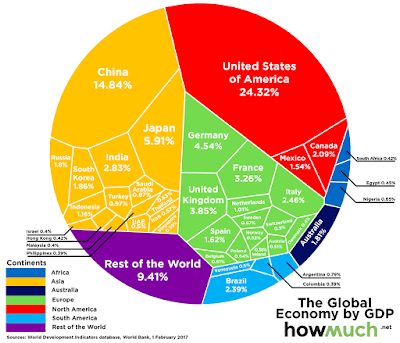
The WEF shares World Bank data plotted by HowMuch about the Global Economy, mapping GDP by geography and proportion... https://www.weforum.org/agenda/2017/12/what-to-expect-for-the-global-economy-in-2018

25 February 2017

Global Pie ~ $74T Economy in One Chart...

Jeff Desjardins at Visual Capitalist shares The $74 Trillion Global Economy in One Chart...
"The full circle, known as a Voronoi Diagram, represents the entirety of the $74 trillion global economy in nominal terms. Meanwhile, each country’s segment is sized accordingly to their percentage of global GDP output. Continents are also grouped together and sorted by color."
http://www.visualcapitalist.com/74-trillion-global-economy-one-chart/ P.S. The actual graphing was done by HowMuch.net

26 November 2016

Urban vs Rural ~ US Economy vs Electorate...

Interesting to compare economic weight vs US voting pattern...
"The 2016 election was a virtual tie, with Hillary Clinton narrowly winning the popular vote, while Donald Trump won just enough states for a majority in the Electoral College. But if elections were based on economic output instead of population, the 2016 election would have been a blowout for Clinton. That’s the takeaway from this graphic produced by the Metropolitan Policy Program at the Brookings Institution. Brookings researchers looked at county-level election returns and compared it with data on economic output for those same counties. It found that the counties Clinton won accounted for 64 percent of the nation’s economic output, while Trump’s counties produced only 36 percent. The reason is simple: Clinton won almost every significant urban county in the US."
http://www.vox.com/new-money/2016/11/23/13715276/clinton-trump-booming-economy

17 November 2014

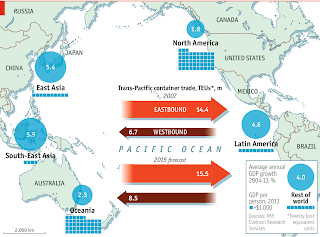
The Pacific Age? ~ Economist Special Report...

The Economist surveys The Pacific Age including the dramatic re-emergence of Asian economies and related trade with the Americas...
"The refrain, “The Mediterranean is the ocean of the past, the Atlantic is the ocean of the present and the Pacific is the ocean of the future,” first heard more than 100 years ago, is still repeated today. Yet exactly half a century after Japan “rejoined the world” (in the phrase of Ian Buruma, a writer) by hosting the Olympics in 1964, the Pacific Age has now clearly arrived. Japan’s economic power may have peaked 25 years ago, but it produced a trans-Pacific competition that now has America and China vying with each other for the title of the world’s largest economy (at purchasing-power parity). All three Pacific nations trade vigorously with one another."
http://www.economist.com/news/special-report/21631795-under-american-leadership-pacific-has-become-engine-room-world-trade

10 November 2014

Making Nature Useless ~ Beyond Peak Farmland

Ronald Bailey at Reason asks Can We Save Nature by Making It Economically Useless?
“Decoupling” human economy from ecology could render large areas of pastures, croplands, and managed forests too remote for exploitation. [...] "The way we will save nature is by rendering it economically worthless," declared Ted Nordhaus. Nordhaus, chairman of the Breakthrough Institute, was speaking at "Making Nature Useless," a seminar sponsored by the D.C.-based think tank Resources for the Future. With that one sentence, he summed up the entire session’s theme. [...] "Why are we using just half of the planet's ice-free land surface?" he asked the audience. Cropland only occupies about 12 percent; pasture, 24 percent; managed forests, 9 percent; cities, 3 percent. About 12 percent of the world's ice-free land, he noted, has been formally set aside for conservation and preservation. What makes that 12 percent different? His answer is that, for the most part, it is too high, too dry, too steep, and too remote. We have saved what we have saved, he suggested, largely because it is not worth anything economically. Most of the lands that are not legally protected but remain unexploited share the same economically off-putting characteristics. [...] humanity is on the cusp of "peak farmland." If current land-use trends continue, an enormous amount of crop and pasture land will be abandoned and returned to nature. [...] Urbanization contributes to the process of decoupling economy and ecology, since fewer hungry people engaged in low productivity subsistence farming mean more land for nature. [...] Analysts with old-fashioned Malthusian mindsets are again decrying the imminent approach of "peak everything" followed by a collapse of civilization. The data presented at Wednesday's seminar points toward a much happier version of "peak everything," as humanity increasingly withdraws from the natural world during the rest of this century."
http://reason.com/archives/2014/11/10/making-nature-useless

29 May 2014

Growth with Depth ~ African Transformation...

K.Y. Amoako, President of the Africa Centre for Economic Transformation, introduces their new report Growth with Depth at African Arguments...
"We hear a lot these days about “Africa Rising” [...] But beneath the surface it’s not that simple. The rate of African growth may have increased, but the structure of most Sub-Saharan economies has not changed much over the past 40 years. [...]
http://africantransformation.org/
Thus the headline statistics disguise both residual problems and inherent vulnerabilities. [...] How can we prevent this pattern repeating itself? This is the question our inaugural Africa Transformation Report aims to answer. Its core argument is that to ensure growth is sustainable and improves the lives of the many, governments need to address structural weaknesses, and deliberately and vigorously promote economic transformation, or growth with DEPTH. This acronym stands for Diversification of production and exports, Export competitiveness, Productivity increases, and Technological advances -- all leading to Human well-being."
Read the full report and see preview...

18 January 2014

Junkyard Planet ~ Global Trash Trading...

The Economist reviews Adam Minter's Junkyard Planet which surveys the emergence of value-from-waste ventures globally...
"The multibillion-dollar recycling trade stands as “one of globalisation’s great, green successes”, writes Adam Minter, an American journalist, in "Junkyard Planet".
http://shanghaiscrap.com/books/junkyard-planet/
It is also a largely unsung one, as under-appreciated as a rusty bike. The industry turns over as much as $500 billion annually, and employs a huge number of people. [...] Dirty, dangerous, cheap to get into and not without romance, the junk business extracts value from what others see as worthless. Mr Minter is not blind to the grim realities of the industry. [...] But any recrimination over these recycling practices is best directed at the rich world and at the increasingly wealthy Chinese who are beginning to match their wasteful, spendthrift counterparts in the West. The recycling industry squeezes value from used goods, but nothing is 100% recyclable."
See excerpt at Shanghai Scrap, Minter's blog!

14 January 2014

Lions Go Digital ~ McK on 'Net Impact in Africa

Very interesting to see new McKinsey report Lions go digital: The Internet’s transformative potential in Africa...
http://www.mckinsey.com/insights/high_tech_telecoms_internet/lions_go_digital_the_internets_transformative_potential_in_africa
"Increased Internet penetration and use could propel private consumption 13 times higher than current levels. Demographic trends -- including urbanization, rising incomes, and a huge generation of young, tech-savvy Africans -- will drive this growth. [...] The Internet’s greatest impact in Africa is likely to be concentrated in six sectors: financial services, education, health, retail, agriculture, and government. Technology-related productivity gains in these sectors could reach $148 billion to $318 billion by 2025, and large populations stand to benefit as a result."
Thanks to Dinfin Mulupi at HWMIIA for spotting this.

07 December 2013

DataViva ~ Visualizing Economic Activity!

http://dataviva.info/
MIT Media Lab Professor César Hidalgo and his Macro Connections group colleagues working with the state of Minas Gerais have created DataViva to visualize and help people understand the full richness of Brazilian economic activity.

14 October 2012

Spillover Cities ~ Economist on Scale Dynamics

The Economist notes that America’s big cities are larger than Europe’s. That has important economic consequences...
"Differences in metropolitan populations may help explain gaps in productivity and incomes. Western Europe’s per-person GDP is 72% of America’s, on a purchasing-power-parity basis. A recent study by the McKinsey Global Institute, the consultancy’s research arm, reckons that some three-quarters of this gap can be chalked up to Europe’s relatively diminutive cities. [...] Cities today have a productivity advantage for different reasons, to do with ideas rather than costs. When one firm in a city comes up with a new technique, product or design, nearby firms may quickly build on it or hire its creator. One firm’s innovation boosts its own productivity but also spills over to other businesses. Companies that prefer seclusion cut themselves off from these "knowledge spillovers."