
Showing posts with label Ecology. Show all posts
Showing posts with label Ecology. Show all posts
09 December 2019
Trophic Cascade ~ Discovery & Eco-Regeneration
PBS Nature shares The Serengeti Rules episode on keystone species in ecosystems and the notion of a "trophic cascade" plus ultimately the prospect of ecosystem regeneration via "upgrading". These ecologists and natural scientists used "living labs" to better disentangle the complexities of biomes, for example, comparing tidepool life with and without starfish, pond life with and without bass fish, Scottish highlands with and without grazing sheep, parks with and without wolves, and kelp forests with and without sea otters.

13 August 2019
Global Forestation ~ Changes over Time...
BBC Reality Check's Jack Goodman asks Deforestation: What’s wrong with planting new forests? 
27 May 2019
Protected Planet ~ Goal of 50% of Earth by 2050
I'm particularly interested in seeing half of Earth be protected by 2050. Towards this goal, Protected Planet shares the World Database on Protected Areas (WDPA) covering both terrestrial and marine protected areas and tracks progress...  The IUCN has a half dozen so-called "Protected Area Management Categories" -- and those are important and worth adding to directly, but I hope we can especially push for enhancement of Category VI "Sustainable Use" with particular eye on private conservancies, land banks, forestry reserves, flood management zones, and potentially even the careful extractions of natural resources. Finally, I hope that we figure out how not to ravage the other half of Earth but rather we green it appropriately (e.g. our cities), share it with nature, and refrain from eco-devastation generally.
The IUCN has a half dozen so-called "Protected Area Management Categories" -- and those are important and worth adding to directly, but I hope we can especially push for enhancement of Category VI "Sustainable Use" with particular eye on private conservancies, land banks, forestry reserves, flood management zones, and potentially even the careful extractions of natural resources. Finally, I hope that we figure out how not to ravage the other half of Earth but rather we green it appropriately (e.g. our cities), share it with nature, and refrain from eco-devastation generally.
14 January 2019
Greening the Desert ~ Alt Perspectives...
Three documentary examples of rehabilitating large-scale damaged ecosystems...
03 January 2017
Bird Migration ~ Seasonal Flight in Americas!
Audubon spotlights a full season of bird migrations visualized! 
"A new animation from the Cornell Lab of Ornithology tracks 118 species along their journeys across the Americas."

16 March 2015
Invaders from the Sea ~ Ships Shift Stowaways!
gCaptain spots Invaders from the Sea...
"The International Maritime Organization partnered with renowned BBC Wildvision to produce this short film [...] offering unique insight into an important environmental issue: the transfer of harmful organisms in ships’ ballast water."
13 January 2015
More Parallels ~ Memetic vs Genetic Pandemics
In 2008, I published an earlier version of this post spotting curious parallels between the geographic spread of non-rational ideas and biological parasitism -- or phrased differently -- between memetic and genetic pandemics. Beyond these two examples from European history -- the expansion of Christianity and the spread of the Great Plague (a.k.a. the Black Death) -- as shown in these two maps... 
 Here we have two more examples, first the spread of Islam...
  And the spread of Buddhism...
  Yes, these happen on different timescales, have diverse points of origin, and varied mechanisms for transmission + replication + mutation. Nevertheless both poisonous ideas and viral poisons are parallel phenomena for humanity to apply scientific methods on, to ever more thoroughly understand, and to ultimately prevail over.
Here we have two more examples, first the spread of Islam...
And the spread of Buddhism... Yes, these happen on different timescales, have diverse points of origin, and varied mechanisms for transmission + replication + mutation. Nevertheless both poisonous ideas and viral poisons are parallel phenomena for humanity to apply scientific methods on, to ever more thoroughly understand, and to ultimately prevail over.
22 December 2014
Liquid Rainbow ~ Colombia's Vibrant River!
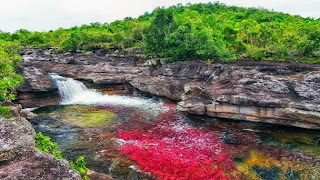
The BBC's Karen Catchpole writes of central Colombia’s 100 Km long Caño Cristales river -- the Liquid Rainbow. Check out photos by Eric Mohl of the river's natural shades of red, blue, yellow, orange and green due to the many hues of the Macarenia Clavigera plant! 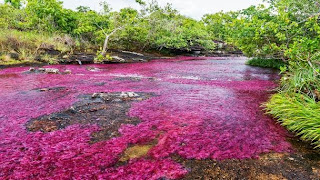

30 November 2014
Decommissioning ~ Retiring GasOil Rigs Correctly
Ingenia's Brian Nixon spotlights Decommissioning North Sea giants...
"A growing number of oil and gas assets have either reached, or are approaching, the end of their economic lifespans, and, in accordance with current regulations, will have to be decommissioned and removed. This presents challenges for the owners and operators of these assets, but offers major business opportunities for engineering consultants, contractors and service specialists. [...] At the moment, there are three accepted strategies for the removal of these larger production facilities, namely piece small, reverse installation and single lift. [...] Until recently, decommissioning has not been considered within the overall lifecycle of an offshore asset. As a result, maintenance regimes have often overlooked key items of plant and equipment that would be needed during the abandonment stages, leading to significant and arguably unnecessary costs. There are welcome signs that this attitude may be changing, with some companies now introducing decommissioning as part of their graduate development programmes. However, further effort is required before decommissioning is fully considered throughout the lifecycle."And to give you a sense of the scale of what it takes to remove such rigs, here's a NatGeo docu on assembling one of the very biggest! And Discovery docu on North Sea Mega Rigs!
10 November 2014
Making Nature Useless ~ Beyond Peak Farmland
Ronald Bailey at Reason asks Can We Save Nature by Making It Economically Useless?

“Decoupling” human economy from ecology could render large areas of pastures, croplands, and managed forests too remote for exploitation. [...] "The way we will save nature is by rendering it economically worthless," declared Ted Nordhaus. Nordhaus, chairman of the Breakthrough Institute, was speaking at "Making Nature Useless," a seminar sponsored by the D.C.-based think tank Resources for the Future. With that one sentence, he summed up the entire session’s theme. [...] "Why are we using just half of the planet's ice-free land surface?" he asked the audience. Cropland only occupies about 12 percent; pasture, 24 percent; managed forests, 9 percent; cities, 3 percent. About 12 percent of the world's ice-free land, he noted, has been formally set aside for conservation and preservation. What makes that 12 percent different? His answer is that, for the most part, it is too high, too dry, too steep, and too remote. We have saved what we have saved, he suggested, largely because it is not worth anything economically. Most of the lands that are not legally protected but remain unexploited share the same economically off-putting characteristics. [...] humanity is on the cusp of "peak farmland." If current land-use trends continue, an enormous amount of crop and pasture land will be abandoned and returned to nature. [...] Urbanization contributes to the process of decoupling economy and ecology, since fewer hungry people engaged in low productivity subsistence farming mean more land for nature. [...] Analysts with old-fashioned Malthusian mindsets are again decrying the imminent approach of "peak everything" followed by a collapse of civilization. The data presented at Wednesday's seminar points toward a much happier version of "peak everything," as humanity increasingly withdraws from the natural world during the rest of this century."
02 July 2014
Jumbo-Gardeners ~ Elephants in the Rainforest
BBC's Power of Nature spotlights the role of elephants in gardening the rainforest, spreading seeds, boosting biodiversity, and more!
11 June 2014
Farm for the Future ~ Sustainable Growth...
UD spots Rebecca Hosking's docu A Farm for the Future exploring...
"How to transform her family’s farm in Devon into a low energy farm for the future, and discovers that nature holds the key. With her father close to retirement, Rebecca returns to her family’s wildlife-friendly farm in Devon, to become the next generation to farm the land. But last year’s high fuel prices were a wake-up call for Rebecca. Realising that all food production in the UK is completely dependent on abundant cheap fossil fuel, particularly oil, she sets out to discover just how secure this oil supply is. Alarmed by the answers, she explores ways of farming without using fossil fuel. With the help of pioneering farmers and growers, Rebecca learns that it is actually nature that holds the key to farming in a low-energy future."
05 June 2014
Whale Power ~ Enhancing Oceanic Abundance;-)
The BBC Power of Nature series spotlights Why whale poo is good for the oceans... and us!
"Oceans envelop three-quarters of our planet’s surface. The survival of three billion people depends on their incredible bounty. Only now are we discovering how the ocean’s largest inhabitants are helping to enhance this. [...] When phytoplankton use up all the nutrients in the water, this vital growth goes into decline. But nature provides an unexpected lifeline, in the form of whale excrement. Whales excrete near the surface, releasing huge amounts of nutrients."
02 April 2014
Save Our Planet ~ Jane Goodall on Technology...
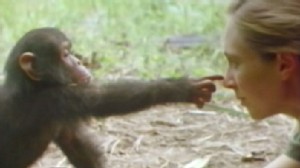
"It is hard for me to believe that I will have lived on planet Earth for 80 years as of this Thursday. I was born on April 3, 1934 and the world has changed in almost all ways possible [via technology which] would have been considered science fiction when I was young. [...] Technology alone will not solve every problem, but it is part of the solution. Let's use technology as a way to amplify our voices in support of the environment. Let's turn to Facebook, Twitter and the myriad other ways to connect and strategize with likeminded individuals about how to make this world better. Let's use technology to extend the reach of our personal influence in support of the planet we love. You cannot get through a single day without having an impact on the world around you -- for better or for worse. What you do makes a difference. Technology can help us all make a positive difference."
16 February 2014
Ecosystem Engineers ~ Wolves Change Rivers?
MissC at Neatorama spots How Wolves Change Rivers by the folks at Sustainable Man...
"When wolves were reintroduced to Yellowstone National Park in the United States after being absent nearly 70 years, the most remarkable "trophic cascade" occurred. What is a trophic cascade and how exactly do wolves change rivers? George Monbiot explains in this movie remix."Update: Whoops, stop the presses, in NYTimes OpEd piece Is the Wolf a Real American Hero?, Yale Forestry & Enviro Studies Post-Doc Arthur Middleton calls "BS" on this simplistic myth...
"This story -- that wolves fixed a broken Yellowstone by killing and frightening elk -- is one of ecology’s most famous. It’s the classic example of what’s called a “trophic cascade,” and has appeared in textbooks, on National Geographic centerfolds and in this newspaper. Americans may know this story better than any other from ecology, and its grip on our imagination is one of the field’s proudest contributions to wildlife conservation. But there is a problem with the story: It’s not true. [...] When we tell the wolf story, we get the Yellowstone story wrong."As DailyKos quotes, this is damning...
"Perhaps the greatest risk of this story is a loss of credibility for the scientists and environmental groups who tell it."
15 January 2014
Homebrew Sensing ~ DIY Enviro Health Tools!
Excellent to see MIT alum and Public Lab for open technology and science founder Jeffrey Warren win the Knight News Challenge grant for The Homebrew Sensing Project: Environmental health monitoring with open source tools...
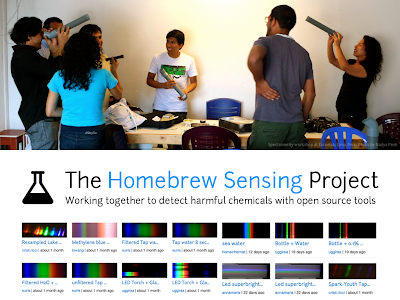
"Just as the Homebrew Computer Club challenged assumptions that computers had no place in the home, the Homebrew Sensing Project explores the potential for spectrometry, a powerful analytic technique for identifying materials, in your home and neighborhood. We have leveraged the emerging Do-It-Yourself movement and the power of open source hardware and software development to bring spectrometric analysis to a new audience -- non-experts investigating and testing their immediate environment. The Homebrew Sensing Project gives everyone access to simple, affordable tools to collect data in their own backyards, providing the information they need to make environmental health decisions."
21 October 2013
Cyanide Slaughter ~ 300 Zim Elephants Poisoned
Peta Thornycroft and Aislinn Laing of The Telegraph share the horrific news of ecocide in Zimbabwe where poachers have slaughtered over 300 elephants and hundreds of collateral animals by deploying cyanide salt-licks and poisoning watering holes as well...


 P.S. Thanks to George Dvorsky at io9 for spotting this.
"The full extent of the devastation wreaked in Hwange, the country's largest national park, has been revealed by legitimate hunters who discovered what conservationists say is the worst single massacre in southern Africa for 25 years. Pictures taken by the hunters, which have been obtained exclusively by The Telegraph, reveal horrific scenes. Parts of the national park, whose more accessible areas are visited by thousands of tourists each year, can be seen from the air to be littered with the deflated corpses of elephants, often with their young calves dead beside them, as well as those of other animals."
P.S. Thanks to George Dvorsky at io9 for spotting this.
22 September 2013
19 August 2013
Sea Level Rise Explorer ~ Map of Coastal Risk
Check out Sea Level Rise Explorer, a zoomable worldmap of elevation relative to sea-level and thus indicator of coastal flood risk... 
15 August 2013
Ken Yeang ~ Talks on Bioclimatic Green Design...
Several talks and interviews with pioneering green designer and eco-architect Ken Yeang. First, Subtropical Cities 2011 Keynote... Work with Nature... CTBUH 2008 Dubai Congress on Ecoskyscrapers... In Person interview (stay past glitches up front)...
Subscribe to:
Posts (Atom)


.svg.png)


