"A new look at antique US railroad maps reveals how cities grew over the past 200 years. The FT's Alan Smith and Steven Bernard trace how cities, people and the economy spread from coast to coast"

"A new look at antique US railroad maps reveals how cities grew over the past 200 years. The FT's Alan Smith and Steven Bernard trace how cities, people and the economy spread from coast to coast"
 Joanna Symons from the Telegraph spotlights 50 Years of the Bullet Train in Japan!
 "Fifty years ago this October [...] Japan’s first Shinkansen, or bullet train, slid out of Tokyo station and gathered speeds of up to 130mph en route for Osaka, heralding a new age of high-speed rail. The Japanese were well ahead of the game. It was 13 years before Italy followed suit, then France with the TGV. But although high-speed trains now glide across hills and plains from Spain to China, Japan’s futuristic-looking bullet train retains an aura that our grime-caked intercity expresses can never capture. [...] Unlike Concorde, the trains have an almost unblemished safety record. Despite Japan’s vulnerability to typhoons and earthquakes, not one of the 10 billion passengers who have used the service since its launch has died as a result of a derailment or collision. [...] Thank you to the bullet train pioneers. They may have been motivated by a need to link Japan’s cities, just as the champions of HS2 are now. But they should be given an award for tourism: these great train routes provide the best possible way to explore this extraordinary country."
"Observation cars with glass walls, deluxe suites and a sleek design -- this is the future of train travel in Japan. Cruise Train is expected to launch in the spring of 2017, but renderings have been released, unveiling a revolutionary blueprint with a £30m price tag. Produced by Ferrari designer Ken Okuyama in collaboration with JR East railways, the projections are based on the seven-star super-luxury Nanatsuboshi in Japan."



"Its main purpose is to increase total transport capacity across the Alps, especially for freight, notably between Germany and Italy, and more particularly to shift freight volumes from road to rail to reduce environmental damage caused by ever-increasing numbers of heavy lorries."
"Where will the train stop? Where can I find an empty seat? Where can I board with my bike? NS and ProRail wanted to improve the transfer process at station platforms: more comfortable, faster and safer. The result of an extensive research and ideation process was a 180 meter long LED strip suspended above the platform showing travellers everything they need to prepare for the next incoming train. Most importantly: using red, orange and green color bands it indicates the occupancy of the different parts of the train. A 3 month pilot at Den Bosch train station proved to be very successful: customers gave NS a significantly higher valuation at the end of the trial period than before. Plans for a nation-wide rollout of the system are at an advanced stage."
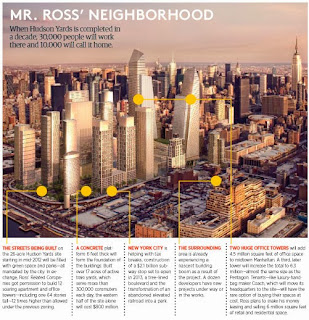 Forbes' Morgan Brennan speaks with Related Cos founder Stephen Ross about the his Hudson Yards development in NYC... P.S. Here's update piece in the DM on The new Manhattan: New York's skyline to be transformed.
"Kenya has formally launched a new, Chinese-financed railway which should extend across East Africa to reach South Sudan, DR Congo and Burundi. The first section will link the Kenyan port of Mombasa to the capital, Nairobi, reducing the journey time from 15 hours to about four. It is said to be the country's biggest infrastructure project since independence 50 years ago. The cost of the railway will be $5.2bn (£3.2bn) -- mostly funded by China. Some Kenyans have complained that the contract was given to the Chinese state-owned China Road and Bridge Corporation (CRBC) without going to tender."

"For 32km (almost 20 miles) the tracks of Petite Ceinture snake through bustling Paris, isolated and largely unseen from street level in deep trenches, long tunnels, and bridges. Nature has reclaimed the space and it has become a haven for wild flowers and animals. The line is officially off-limits to the public, but this hasn't stopped many people attempting to explore it. There is now a fierce debate in the French capital about what to do with the tracks and stations of the Petite Ceinture that still remain."

"China's Yong Sheng is an unremarkable ship that is about to make history. It is the first container-transporting vessel to sail to Europe from China through the Arctic rather than taking the usual southerly route through the Suez Canal, shaving two weeks off the regular travel time in the process. The 19,000-ton Yong Sheng, operated by China's state-controlled Cosco Group, left the port of Dalian Aug. 8 and is scheduled to reach Rotterdam, in the Netherlands, via the Bering Strait Sept. 11. The travel time of about 35 days compares with the average of 48 days it would normally take to journey through the Suez Canal and Mediterranean Sea."
 Of course, things get even more interesting when you throw in the prospects of trans-Siberian railway links...
 "So which routes have been tested? [...]
The freight lead times are very good in comparison to sea freight where the usual shipping time can be 36 days or more depending on the end location in Europe. The scale of the railway is immense as it crosses 11 time zones and more than 11,000 km."
- Shanghai China to Duisburg Germany (18 Days)
- Chongqing to Duisburg (16 Days)
- Xiangtang, China, to Hamburg (17 Days)


"Since service began on Memorial Day weekend, the [CapeFlyer] train has transported nearly 9,000 passengers -- almost 900 of them last weekend -- between Boston and Hyannis. The increasingly popular venture has collected enough fares to cover the approximately $165,000 annual cost of operating the train, and the service may be extended until Columbus Day. [...] Train service between Boston and the Cape has been attempted several times over the years, but this iteration has a better chance of success [...] Bike racks in the first car of the train have hit capacity more than once, forcing the train crew to find other places to stow them. “It has opened up a crowd of people that wouldn’t normally come here because they don’t want to drive,” Wurfbain said. “Without taking that trip with the car, it’s so much more pleasant.” [...] Restored rail lines make the ride faster and smoother, he said, while high gas prices and the desire to avoid traffic jams like the 25-mile backup over the 4th of July weekend are prompting more people to leave their cars at home."


