 Curiously enough, most maps like this only show land incidence. But surely we could float massive solar panels out on swathes of ocean? In fact, perhaps we should hoover up the massive ocean gyres of waste plastic and convert these into floatation for PV paneling.
Showing posts with label Energy. Show all posts
Showing posts with label Energy. Show all posts
01 June 2019
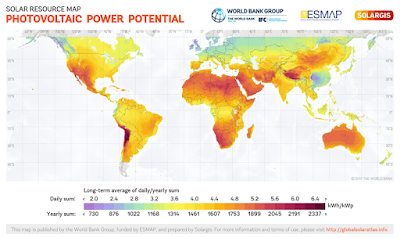
PV Potential ~ Mapping Sunpower Worldwide...
The Sun is a giant thermonuclear reactor in the sky powerbeaming 24x7. A tiny sliver hits the daily rotating Earth and then you have to discount for angles and overcasts. When all's accounted for, here's the resulting worldmap of terrestrial potential for PV or photovoltaic sunpower... Curiously enough, most maps like this only show land incidence. But surely we could float massive solar panels out on swathes of ocean? In fact, perhaps we should hoover up the massive ocean gyres of waste plastic and convert these into floatation for PV paneling.
Curiously enough, most maps like this only show land incidence. But surely we could float massive solar panels out on swathes of ocean? In fact, perhaps we should hoover up the massive ocean gyres of waste plastic and convert these into floatation for PV paneling.

01 August 2017
Power Barges ~ Flexible Floating Infrastructure
Thanks to gCaptain for spotting an improved Power Barge system...

"A new modular medium speed engine power barge design [...] This radiator-cooled modular power barge design permits the same hull to be utilized with a range of power outputs from 80 MW to 180 MW. [...] The new design is presently being modified for dual fuel and natural gas operations to suit combined operations with LNG […] and combined cycle systems for specific market opportunities."Power barges are the fastest way to ramp up electricity (and cogen + water desal) infrastructure in coastal or navigable river areas. By floating in and being modular, they can be incrementally added to (with more barges) or floated out and moved to new or better location (and/or refurbished). See also my previous posts on this topic!
03 September 2015
Development Ventures ~ Exponential Prosperity!
My MIT colleague Alex (Sandy) Pentland and I are offering our Development Ventures action lab class this Fall 2015 at the Media Lab starting Thursday September 10th from 10a-12noon, with special focus on frugal, DIY, and ultraffordable technologies as well as exponential innovations including mobiles, big data, and analytics. This will be our 15th year!
 Every year, we look forward to the latest new venture concepts our students propose -- in domains ranging from Health & Wellness, Energy & Sustainability, Education & Creativity, Commerce & Financial Services, Civic Engagement and beyond -- and we try to help the most motivated teams and promising ideas actually start and thrive! Alumcos since 2001 include FirstMileSolutions/United Villages, blueEnergy, WAY Systems, Dimagi, Howtoons, CellBazaar, Global Cycle Solutions/GCS, Assured Labor/EmpleoListo, ClickDiagnostics/mPower/ClickMedix, Dinube, Sanergy, WoundPump/WiiCare, ESSMART, Wecyclers, Ghonsla, Logistimo, Apportunidades, CrowdSOS/WiseSystems, MoringaConnect, TrueAfrica, MDaaS, MAX, and more. What will blossom this year?
03 August 2015

28 September 2014
Faraday ~ Working-Class Scientist-Inventor!
One of my favorite Barron's columns is The Long View by historian and author John Steele Gordon. This week he spotlights Michael Faraday: Working-Class Hero...
"Faraday would be the first great man of science to have a working-class background. Because the family had little money, Faraday received only the most rudimentary formal education. Indeed, he never mastered mathematics beyond simple algebra, an astonishing fact for someone who would become one of the world's greatest physicists. But if he had little formal education, he was a voracious autodidact. [The Danish scientist] Ørsted discovered that an electric current running through a wire induces a magnetic field around the wire. This was the first indication that electricity and magnetism, long thought to be completely different forces, must have a connection. [To explore this, Faraday] hung a copper wire, able to rotate freely, from a metal support. The wire reached into a vessel below containing a magnet in a pool of mercury. When he attached a battery to the support, the copper wire began to rotate around the magnet, following the lines of the magnetic field (a term Faraday coined) in the mercury. Faraday had converted electrical energy into mechanical, work-doing energy. In other words, he had invented an electric motor [...] One of the attributes of great scientists is a knack for asking the right question. And Faraday wondered, since an electric current could induce a magnetic field, whether a magnetic field could induce an electric current. [...] in 1829, Faraday found the answer to his question. He wrapped two copper coils on opposite sides of an iron ring. He found that when he attached a battery to one coil, there was a momentary electric current generated in the other coil. And when he disconnected the battery, there was a second momentary current. He soon found that it was changes in the magnetic field that induced the current. By simply keeping the magnetic field in continuous motion, he was able to generate a steady current. Faraday had invented the generator, a device that turns mechanical energy into electrical energy -- the opposite of the electric motor. It was the means of providing a bottomless supply of electric power, and the modern world could be born."Truly one of the heroes of progress and civilization! See more in this Great Moments in Science and Technology video...
01 September 2014
Development Ventures ~ Solving Global Problems
My MIT colleague Alex (Sandy) Pentland and I are again hosting our Development Ventures action lab class this Fall 2014 at the Media Lab starting this Thursday September 4th from 10a-12noon, with special focus on frugal, DIY, and ultraffordable technologies as well as exponential innovations including mobiles, big data, and analytics.  As always, we look forward to the latest new venture concepts our students propose -- in domains ranging from Health & Wellness, Energy & Sustainability, Education & Creativity, Commerce & Financial Services, Civic Engagement and beyond -- and we try to help the most motivated teams and promising ideas actually start and thrive!
As always, we look forward to the latest new venture concepts our students propose -- in domains ranging from Health & Wellness, Energy & Sustainability, Education & Creativity, Commerce & Financial Services, Civic Engagement and beyond -- and we try to help the most motivated teams and promising ideas actually start and thrive!
10 June 2014
R.I.P. Peter Glaser ~ Solar Power Satelliteer...
Sad to read that visionary engineer Peter Glaser has passed away at age 90. Glaser worked for nearly a half-century at ADL, the pioneering technology & management consultancy, but his big passion was satellite-mounted solar panels which would beam power down to ground.
05 June 2014
Macondo Blowout ~ Deepwater Disaster Anime
gCaptain spots the CSB's draft investigation report video anime of BP's Macondo well blowout and Deepwater Horizon disaster...
"The blowout preventer (BOP) that was intended to shut off the flow of high-pressure oil and gas from the Macondo well in the Gulf of Mexico during the disaster on the Deepwater Horizon drilling rig on April 20, 2010, failed to seal the well because drill pipe buckled for reasons the offshore drilling industry remains largely unaware of, according to a new two-volume draft investigation report released on June 5, 2014, by the U.S. Chemical Safety Board (CSB)."
19 May 2014
Epic Swiss Build ~ Pumped-Storage Gigaproject
My MIT colleague Jonas Brunschwig spotted this really epic Swiss engineering project Linthal 2015!
"A new underground pumped-storage power plant will be used to pump water from Lake Limmern back up to Lake Mutt, which is 630 m higher. When needed, it can then be used to generate electricity again. The new facility will boast pump and turbine capacities of 1,000 MW each. This will boost the output of Kraftwerke Linth-Limmern AG (KLL) from the current 480 MW or so to 1,480 MW. In terms of performance, this will put it on a par with the Leibstadt nuclear power plant or the Cleuson Dixence hydroelectric power plant. This will serve to safeguard the future security of electricity supply for northeastern and central Switzerland. Construction is expected to take about five years, and the plant should go into operation in 2015/2016."Check out build video (in German, but spectacular graphics!-)
15 January 2014
Flight Plan ~ V Formations Bird Dynamics!
CSMonitor's Sudeshna Chowdhury shares Why do birds fly in V? highlighting research by Royal Veterinary College, University of London biologists Steven Portugal and James Usherwood on bird flight dynamics! Check out Nature video...
29 December 2013
Building Turbofans ~ Rolls-Royce's Trent Engine!
Epic engineering masterpiece, the Rolls-Royce Trent turbofan engine!
02 September 2013
MIT Development Ventures ~ Action Lab 2013
My MIT colleague Alex (Sandy) Pentland and I are again hosting our Development Ventures action lab class this Fall 2013 at the Media Lab starting this Thursday, 5 September, with special focus on frugal, DIY, and ultraffordable technologies as well as exponential innovations including mobiles, big data, and analytics.
 As always, we look forward to the latest new venture concepts our students propose -- in domains ranging from Health & Wellness, Energy & Sustainability, Education & Creativity, Commerce & Financial Services, Civic Engagement and beyond -- and we try to help the most motivated teams and promising ideas actually start and thrive!
05 August 2013
Extreme Engineering ~ Statoil & Maersk Lead...
14 July 2013
11 June 2013
SolSource ~ MIT Alumco Solar Cooker Kickstarts!
Our MIT Development Ventures alumco SolSource is Kickstarting!
"Our core mission is to bring innovative energy solutions to people around the world. We began this quest working with rural Himalayan families to help find a solution to meet their energy needs. Five years and thirteen prototypes later, we’ve created a product that people love and significantly improves their quality of life. Right now, many families rely on SolSource for their daily cooking needs. SolSource saves them time and money, reduces their exposure to harmful stove pollution, and preserves the environment."
Shale Potential ~ Global Map of Frackable Fuels...
Kevin Bullis in TR spots global shale potential... 
"The EIA report concludes that Russia has even more technically recoverable shale oil than the United States. Three countries have more shale gas—China, Argentina, and Algeria. Geologists have long known that some shale deposits contain large amounts of oil and gas, but it’s only recently that hydraulic fracturing and horizontal drilling technology have made it feasible to extract."
09 May 2013
21 April 2013
Plotting History ~ Longterm Human Trendlines...
Lisa Wade spotlights a History of American Energy Use...  Arnulf Grüblera, Nebojša Nakićenovića, and David Victor plot the Dynamics of energy technologies and global change...


Arnulf Grüblera, Nebojša Nakićenovića, and David Victor plot the Dynamics of energy technologies and global change...
12 March 2013
Gas Hydrates ~ BBC & USGS on "Burning Ice"
BBC reports Japan extracts gas from methane hydrate in world first...
"Japan says it has successfully extracted natural gas from frozen methane hydrate off its central coast, in a world first. Methane hydrates, or clathrates, are a type of frozen "cage" of molecules of methane and water. [...] Vast deposits are thought to exist, rivaling known reserves of traditional fossil fuels."Here's USGS infopiece showing "burning ice"...
16 December 2012
Invest in Africa ~ FT Spots Tullow's Campaign...

"...as founder of “Invest in Africa”, Tullow Oil has emblazoned the name of the campaign group on to TV screens in a sponsorship deal with Sunderland football club in northeast England [...] Aidan Heavey, Tullow’s chief executive, said: “At a stroke, this association will make Sunderland the most popular football club in Africa.” Mr Heavey’s claim will appear to many as quixotic. Yet it clearly reflects a desire by Tullow and its Irish founder to act as a cheerleader for investment, rather than aid, in the continent where the Chiswick-based company continues to concentrate its attention. [...] since its creation in 1985, Tullow’s main focus has been in Africa, where it now operates in 15 countries and claims to be the continent’s leading independent oil company. The stated aim of Mr Heavey’s campaign vehicle is to attract the support of other companies operating successfully in the region, challenge misconceptions about doing business on the continent and “tackle the gap between the perception and reality of doing business in Africa”. Tullow itself claims credit for encouraging local recruitment and training of senior management in the territories where it operates, as well as job creation and investment."Very compelling indeed! Here's their promo film...
Subscribe to:
Posts (Atom)


.svg.png)


