Showing posts with label NYTimes. Show all posts

19 November 2018

China's American Dream ~ Growth Infographics!

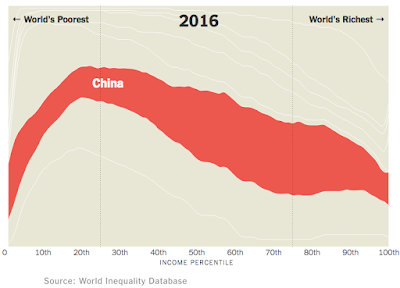
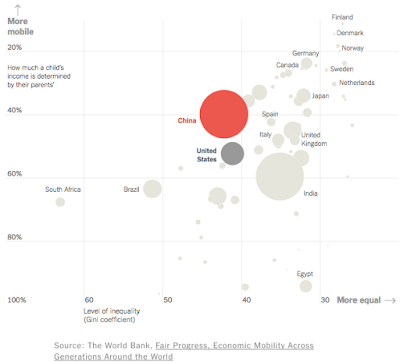
As part of the China Rules series, Javier Hernandez and Quoctrung Bui write in the NYTimes that The American Dream Is Alive. In China...
"In a country still haunted by the Cultural Revolution, where politics are tightly circumscribed by an authoritarian state, the Chinese are now among the most optimistic people in the world -- much more so than Americans and Europeans, according to public opinion surveys. What has changed? Most of all, an economic expansion without precedent in modern history. Eight hundred million people have risen out of poverty. That’s two and a half times the population of the United States. [...] China used to make up much of the world’s poor. Now it makes up much of the world’s middle class."
https://www.nytimes.com/interactive/2018/11/18/world/asia/china-social-mobility.htmlhttps://www.nytimes.com/interactive/2018/11/18/world/asia/china-social-mobility.htmlhttps://www.nytimes.com/interactive/2018/11/18/world/asia/china-social-mobility.htmlhttps://www.nytimes.com/interactive/2018/11/18/world/asia/china-social-mobility.html

04 March 2017

R.I.P. Paul Kangas ~ "The Best of Good Buys!"

https://www.nytimes.com/2017/03/02/business/paul-kangas-dead.html?_r=0
Alas, Paul Kangas, the Walter Cronkite of business broadcasting has passed away. He started the broadcasting of business info. Indeed, others, like CNBC, “all started mimicking us.” “But as my wife, who is an artist, says,” he added, “the original is always the best.” I personally loved his panache and his epic and memorable signature signoff...
“Wishing all of you the best of good buys”

18 November 2016

R.I.P. Jay W Forrester ~ Sociodynamics Pioneer...

Alas, RIP, Jay W Forrester. Through his panache, presence, and personal feedback (to me!) and through his inventing core memory & CNC machines, the Whirlwind real-time digital computer, Sage air defense network, Lincoln Labs, building up the MIT Sloan School, teaching Professors Ed Roberts, John Sterman, Donella Meadows, Jurgen Randers, etc, et al, founding the System Dynamics discipline, and providing essential inspiration to dozens of MIT alumcos -- i.e. his students were founders of Digital Equipment Corp (DEC), MITRE, 3Com, Pugh-Roberts, Patni Computer Systems (birth of Indian offshoring), Ventana, and many, many more -- plus inspirational role in creating SimCity, pioneering management flight simulators, e.g. creating the Beer Game, writing Industrial Dynamics, Urban Dynamics, World Dynamics and provoking LImits to Growth, C-ROADS simulators, etc, etc, Jay Forrester remains an awesome and iconoclastic inventor, a personal inspiration to me and thousands more, and one of MIT's most epic and innovative heroes. I'm so sad at losing him but so happy to have had him too...

16 April 2016

Rethinking the Map ~ Emergent US Megaregions

NYTimes piece by Parag Khanna on A New Map for America spotlights how the lower 48 could be realigned into seven megaregions...
"America is increasingly divided not between red states and blue states, but between connected hubs and disconnected backwaters. [...] Federal policy should refocus on helping these nascent archipelagos prosper, and helping others emerge, in places like Minneapolis and Memphis, collectively forming a lattice of productive metro-regions efficiently connected through better highways, railways and fiber-optic cables: a United City-States of America.  Similar shifts can be found around the world. Despite millenniums of cultivated cultural and linguistic provinces, China is transcending its traditional internal boundaries to become an empire of 26 megacity clusters with populations of up to 100 million each, centered around hubs such as Beijing, Shanghai, Guangzhou and Chongqing-Chengdu. Over time these clusters, whose borders fluctuate based on population and economic growth..."
http://www.nytimes.com/2016/04/17/opinion/sunday/a-new-map-for-america.html?_r=0

13 July 2015

Cascadia Tsunami ~ Understanding Tectonic Risk

Kathryn Schulz writes in The New Yorker of The Really Big One...
"An earthquake will destroy a sizable portion of the coastal Northwest. The question is when. [...] At approximately nine o’ clock at night on January 26, 1700, a magnitude-9.0 earthquake struck the Pacific Northwest, causing sudden land subsidence, drowning coastal forests, and, out in the ocean, lifting up a wave half the length of a continent. It took roughly fifteen minutes for the Eastern half of that wave to strike the Northwest coast. It took ten hours for the other half to cross the ocean. [...] We now know that the Pacific Northwest has experienced forty-one subduction-zone earthquakes in the past ten thousand years. If you divide ten thousand by forty-one, you get two hundred and forty-three, which is Cascadia’s recurrence interval: the average amount of time that elapses between earthquakes. That timespan is dangerous both because it is too long -- long enough for us to unwittingly build an entire civilization on top of our continent’s worst fault line -- and because it is not long enough. Counting from the earthquake of 1700, we are now three hundred and fifteen years into a two-hundred-and-forty-three-year cycle."
Here's a simulation of what happened back in 1700... And here's a geologist's discussion... Finally, documentary shock & awe imagery... NYTimes' DotEarthling Andrew Revkin weighs in too, with nice infographic showing past 8.0 and 9.0 events over 10K years... http://dotearth.blogs.nytimes.com/2015/07/13/a-chilling-update-on-the-ticking-seismic-bomb-off-the-u-s-northwest-coast/?_r=0

27 February 2015

R.I.P. Leonard Nimoy ~ Live Long and Prosper...

Alas Leonard Nimoy has passed away at 83 of chronic obstructive pulmonary disease, which he attributed to years of smoking cigs. Born and raised in Boston's West End by immigrant Jews from Soviet Ukraine, he's perhaps best remembered for his enduring portrayal of the mostly logical half-Vulcan Mr Spock on Star Trek, where his signature hand-gesture emerged and also the tagline which inspired me and so many others -- "Live Long and Prosper"

20 January 2015

Millionaire's Matchstick ~ NYC's Pricey Sky Vistas!

Stephen Farrell of the NYTimes writes of A View That Costs $81 Million from the top of the so-called Millionaire's Matchstick...
"New York’s tallest residential building, 432 Park Avenue, reached its full height on Friday, 1,396 feet. It opens next year and the penthouse views, in all directions, are spectacular."

16 November 2014

Learning From Sandy ~ Can NYC Really Prepare?

Superstorm Sandy -- two years ago, this past two weeks or so -- exceeded expectations and caught much of NYC and our American eastern seaboard surroundings short. Surge flooding, power loss, transit disruption, property damage, and more. Watch the docus to get a sense of scale and ferocity... The NYC Comptroller has upped estimates of property at-risk and the NYC leadership are on the ball pushing for change. DotEarthling Andrew Revkin spotlights NYC's softer relationship with the sea and especially NYTimes colleague Alan Feuer's Building for the Next Big Storm ~ After Hurricane Sandy, New York Rebuilds for the Future...
"In the next four decades, scholars say, sea levels are expected to rise by as much as 30 inches, and if the worst projections come to pass, about 800,000 city residents could find themselves living with the threat of being swamped. According to an insurance report commissioned by the city, if New York suffers another storm like Sandy in the early 2050s, when ocean levels and the population are likely to be higher, it could cause $90 billion in damage -- almost five times the cost of the initial storm."
Some radical new thinking is needed about coastal flood resilience, defence-in-depth, room for the water, more savvy infrastructure, and more... http://dotearth.blogs.nytimes.com/2014/10/26/two-years-after-sandys-surge-new-york-city-shifts-toward-a-softer-relationship-with-the-sea/ Especially watch this series of speakers highlighting plans for Recovery and Resiliency at NYC's Hospitals (NYU Langone, Bellevue, etc)... P.S. Here's some historical nuggets, including my commentary on 27 Oct 2012 Superstorm Sandy ~ Tracking Emergent Weather, 28 Oct NYC Evac Map ~ Warning Zones for Sandy, looking at big picture on 29 Oct Imaging Sandy ~ NASA/NOAA Timelapse, the disaster retrospective Into the Storm ~ Final Days of Tallship Bounty, NYC Mayor Bloomberg announcing PlaNYC, early thoughts on resiliency, the power of drills in the hospital evacuations, and specific inventions, like the Tunnel Plug!

02 November 2014

Prelude ~ NYTimes on Biggest Ship in the World

The NYTimes spotlights Shell's Prelude with photosynth imagery by Stephen Mallon and Jon Huang...
"Owing to shifts in oil prices and a change in the climate of energy arbitrage, a vast amount of usable natural gas -- an estimated three trillion cubic feet of it -- is now profitable and waiting to be tapped within an area called Browse Basin, under the Indian Ocean, roughly 125 miles northwest of Australia. That’s where Prelude will soon be towed, then fixed."

25 March 2014

Beneath Cities ~ Decaying Infrastructure & Death

In NYTimes, Patrick McGeehan, Russ Buettner, and David Chen share scandal: Beneath Cities, a Decaying Tangle of Gas Pipes...
"It is a danger hidden beneath the streets of New York City, unseen and rarely noticed: 6,302 miles of pipes transporting natural gas. [...] The perilous state of New York City’s underground network, one of the oldest in the country [is] a glaring example of America’s crumbling infrastructure. [...] Communities across the country have been struggling to replace thousands of miles of these old, metal pipes with pipes made of plastic or specially coated steel that are less prone to leakage. Few, however, face as daunting a challenge as New York City. To replace all of the old mains in its network right now would cost as much as $10 billion, Con Edison estimates. Much of that expense would fall on the residents and businesses that use the gas for heating and cooking. [...] “Some of this aging infrastructure has reached the end of its useful life” [...] “It’s a major ordeal in a city like New York to just start digging things up.”
Yikes, surely there's a better way to design, build, and maintain cities?! Here's the mess below as visualized by Larry Buchanan's infographic and Robert Stolarik's photos... http://www.nytimes.com/interactive/2014/03/23/nyregion/the-network-of-pipes-under-manhattans-streets.html?_r=0

16 February 2014

Ecosystem Engineers ~ Wolves Change Rivers?

MissC at Neatorama spots How Wolves Change Rivers by the folks at Sustainable Man...
"When wolves were reintroduced to Yellowstone National Park in the United States after being absent nearly 70 years, the most remarkable "trophic cascade" occurred. What is a trophic cascade and how exactly do wolves change rivers? George Monbiot explains in this movie remix."
Update: Whoops, stop the presses, in NYTimes OpEd piece Is the Wolf a Real American Hero?, Yale Forestry & Enviro Studies Post-Doc Arthur Middleton calls "BS" on this simplistic myth...
"This story -- that wolves fixed a broken Yellowstone by killing and frightening elk -- is one of ecology’s most famous. It’s the classic example of what’s called a “trophic cascade,” and has appeared in textbooks, on National Geographic centerfolds and in this newspaper. Americans may know this story better than any other from ecology, and its grip on our imagination is one of the field’s proudest contributions to wildlife conservation. But there is a problem with the story: It’s not true. [...] When we tell the wolf story, we get the Yellowstone story wrong."
As DailyKos quotes, this is damning...
"Perhaps the greatest risk of this story is a loss of credibility for the scientists and environmental groups who tell it."

28 December 2013

Malthus Miffed ~ Cohen on Human Demography

NYTimes DotEarthling Andrew Revkin writes in his Tutorial on Humanity’s Path to and Beyond 7 Billion about "meshing human development and planetary limits" and spotlights Prof Joel Cohen's Malthus Miffed: Are People the Problem, the Solution, or Both?

04 December 2013

Curing Aging ~ de Grey on Healthy Longevity!

Thanks to Johnny Boston at H+ for spotlighting Galactic Public Archives interview with a genial modern-day Merlin, Dr Aubrey de Grey, on addressing the world's most important problem -- the diseases and ravages of aging -- via Strategies for Engineered Negligible Senescence or SENS... This is especially important in light of the neo-luddite anti-gerontechnology movement festering in our society, for instance Daniel Callahan's screed in the NYTimes On Dying After Your Time.

20 November 2013

Roborouter ~ MIT's Image-Guided Powertools

http://web.mit.edu/newsoffice/2012/automated-handheld-router-for-woodworking-0808.htmlAnne Eisenberg writes nice story in NYTimes, For the Home Workshop, a GPS for Power Tools, on Alec Rivers and Ilan Moyer's roborouter image-guided powertool based on their MIT research on position-correcting tools with Fredo Durand...
"As soon as you put the tool on the material, it knows where it is,” Mr. Rivers said. “The screen shows you the path you are on, as well as the pattern you’re going to cut.” When the bit comes within a quarter inch of the pattern, tiny motors in the device go to work, keeping the tool along its correct route. Ilan E. Moyer, a graduate student in mechanical engineering at M.I.T., designed the hardware for the latest prototype of the device. “If you are straying from the path, going to the left,” failing to follow the exact design, he said, “the motors will shift the tool to the right to keep it on the path.” Mr. Rivers said that “all you have to do is get within the ballpark freehand.” Then the “tool GPS” and small-scale computer adjustments guarantee a precise cut."

16 September 2013

Sustainability-by-Design ~ NYT OpEd on Overpop

Read today's bold OpEd in NYTimes by Professor Erle Ellis asserting that Overpopulation Is Not the Problem...
"The conditions that sustain humanity are not natural and never have been. Since prehistory, human populations have used technologies and engineered ecosystems to sustain populations well beyond the capabilities of unaltered “natural” ecosystems. [...] Our predecessors in the genus Homo used social hunting strategies and tools of stone and fire to extract more sustenance from landscapes than would otherwise be possible. And, of course, Homo sapiens went much further [...] Who knows what will be possible with the technologies of the future? The important message from these rough numbers should be clear. There really is no such thing as a human carrying capacity. We are nothing at all like bacteria in a petri dish. Why is it that highly trained natural scientists don’t understand this? [...] The science of human sustenance is inherently a social science. Neither physics nor chemistry nor even biology is adequate to understand how it has been possible for one species to reshape both its own future and the destiny of an entire planet. This is the science of the Anthropocene. [...] The only limits to creating a planet that future generations will be proud of are our imaginations and our social systems. In moving toward a better Anthropocene, the environment will be what we make it."
FYI, DeLong shares Human Population estimates...

14 September 2013

Gearlegs ~ Jumping Juvenile Issus Coleoptratus!

Sindya Bhanoo in the NYTimes Observatory column spots the study by Bristol researchers Malcolm Burrows and Gregory Sutton of the gear mechanism in the hind legs of the juvenile Issus Coleoptratus...
"...a champion jumper found in gardens throughout Europe. Its coglike joints were first described in the 1950s, but it was only with advanced high-speed video that the scientists were able to prove how the joints worked. Before the insect leaps forward, it hooks its gear teeth on one leg to the gear teeth on the other. That way, Dr. Burrows said, “the power is delivered to both legs at the same time, so no leg is twisted.” The legs are synchronized within 30 millionths of a second."

21 August 2013

Subversive Currents ~ China Fears Seven Perils...

Chris Buckley in the NYTimes reveals that China's unelected and dictatorial Communist Party leadership fear that...
"...power could escape their grip [...] unless the party eradicates seven subversive currents coursing through Chinese society."
These seven perils include...
  • “Western constitutional democracy,” 
  • Promoting “universal values” of human rights,
  • Western-inspired notions of media independence and civic participation,
  • Ardently pro-market “neo-liberalism,” 
  •  “Nihilist” criticisms of the party’s traumatic past. 
Surely, however, any truly strong and legitimate authority fears no criticism, embraces shared values, and benefits from active citizen participation? Or do the so-called "leaders" of China fear the light of freedom and the true voice of the people?