Showing posts with label Gigaproject. Show all posts
Showing posts with label Gigaproject. Show all posts
18 December 2014
Prelude Progress ~ Epic Ship Construction Porn!
gCaptain spotlights my favorite current gigaproject, the Shell Prelude! Here's earlier intro to Prelude FLNG.

02 November 2014
Prelude ~ NYTimes on Biggest Ship in the World
The NYTimes spotlights Shell's Prelude with photosynth imagery by Stephen Mallon and Jon Huang...
"Owing to shifts in oil prices and a change in the climate of energy arbitrage, a vast amount of usable natural gas -- an estimated three trillion cubic feet of it -- is now profitable and waiting to be tapped within an area called Browse Basin, under the Indian Ocean, roughly 125 miles northwest of Australia. That’s where Prelude will soon be towed, then fixed."
Dubai World Central ~ Emergent Aerotropolis!
Check out promo video for Dubai World Central, a ginormous master-planned and emergent aerotropolis and translogistics center!
04 December 2013
Curing Aging ~ de Grey on Healthy Longevity!
Thanks to Johnny Boston at H+ for spotlighting Galactic Public Archives interview with a genial modern-day Merlin, Dr Aubrey de Grey, on addressing the world's most important problem -- the diseases and ravages of aging -- via Strategies for Engineered Negligible Senescence or SENS... This is especially important in light of the neo-luddite anti-gerontechnology movement festering in our society, for instance Daniel Callahan's screed in the NYTimes On Dying After Your Time.
28 November 2013
East African Railway ~ Kenya Starts Building...
The BBC writes Kenya launches new railway to reach South Sudan and Burundi...

"Kenya has formally launched a new, Chinese-financed railway which should extend across East Africa to reach South Sudan, DR Congo and Burundi. The first section will link the Kenyan port of Mombasa to the capital, Nairobi, reducing the journey time from 15 hours to about four. It is said to be the country's biggest infrastructure project since independence 50 years ago. The cost of the railway will be $5.2bn (£3.2bn) -- mostly funded by China. Some Kenyans have complained that the contract was given to the Chinese state-owned China Road and Bridge Corporation (CRBC) without going to tender."
04 August 2013
Port of Rotterdam ~ Euro Translogistics Hub!
One of my favorite places to visit as a kid, the Port of Rotterdam!
28 January 2013
Extraordinary Measures ~ On Fixing Big Problems
Bill Gates writes in WSJournal about Extraordinary Measures ~ his plan to fix the worlds biggest problems...
"In the past year, I have been struck by how important measurement is to improving the human condition. You can achieve incredible progress if you set a clear goal and find a measure that will drive progress toward that goal. [...] An innovation -- whether it's a new vaccine or an improved seed -- can't have an impact unless it reaches the people who will benefit from it. We need innovations in measurement to find new, effective ways to deliver those tools and services to the clinics, family farms and classrooms that need them. [...] The lives of the poorest have improved more rapidly in the past 15 years than ever before. And I am optimistic that we will do even better in the next 15 years. The process I have described -- setting clear goals, choosing an approach, measuring results, and then using those measurements to continually refine our approach -- helps us to deliver tools and services to everybody who will benefit."Gates gives multiple examples from health, education, agriculture and others.
26 August 2012
Big Dig ~ Boston's Translogistics Gigaproject
People complained while it was under construction -- and it certainly had its share of accidents, overruns, delays, and disasters -- but when you look at the ginormous nature of Boston's Big Dig gigaproject, you realize just how remarkable an engineering feat it has been!
29 January 2012
Eko Atlantic ~ Huge Nigerian Urban Development!
 Very intriguing to read more about the progress of the huge 9 square kilometer Eko Atlantic gigaproject off Victoria Island in Nigerian megacity Lagos...
 As of last year, the landfill and seawall are progressing...
 And here's one view of the envisioned future city...
  With various planned districts of Eko Atlantic...
  Here's the official developer's "inside story" promo video... CNN Inside Africa reports... ABN interviews David Frame, MD of South Energyx Nigeria Limited part of the Chagoury Group, developers and city planners behind the project... Finally, here's Lagos State Governor Babatunde Fashola speaking about Eko Atlantic... (See also 2009 piece by Africa Unchained's Emeka Okafor)
08 January 2012
African Seaports ~ Infra'ture Investment Needed...
Tremendous infrastructure investments in ports & ways are urgently needed to enable Africans to properly participate in the global economy. Indeed, I've written before about vital translogistics, accelerating infrastructure, and transport corridor plans as well as the need for creative thinking about infrastructure financing together with the challenges of special Chinese "deals". So it's very interesting to read the AfDB's key message Too many ports handle Africa’s maritime trade traffic -- few of them large enough to attract major shipping lines... 
"A greater degree of regional port planning would make it possible to select hubs large enough to offer efficient transshipment services. A hub system would help to lower transport costs."Check out their map of African ports showing their scale...
09 December 2011
Rail Co-Development ~ Collier on African Infra...
 Thanks to my MIT colleague Ethan Zuckerman for spotting this fascinating piece by Oxford's Paul Collier in IMF Finance & Development on Building an African Infrastructure about orchestrated co-development of railways cutting across industries and polities...
 "Key political decisions are needed to build critical rail networks for a continent well suited to them. [Alas] during the past half-century Africa’s rail network, never very extensive, has shrunk. [But] by radically reducing transportation costs, railways could open up vast tracts of Africa to economic opportunities, especially in agriculture and mining, which many countries are relying on for future growth. The continent needs a decade of massive investment in rail networks.What might accelerate such investment?
The core economic challenge is to organize the rail network in a way that meets the needs both of the extraction industries and of agriculture. Mining operations require railways and ports. Were there no agricultural users, the mining companies themselves could finance the rail network from some of the high profits generated by extraction. As long as these rail links serve agriculture and resource-extraction users, agriculture need pay only the marginal cost of operation. In effect, the differential profitability of mines and agriculture creates the potential for price discrimination between them. Mining companies, eager to open up resource-laden lands, have offered to set up such railways, even though these companies are not likely to welcome or desire multifunctional use of the rail network. [...] It would be beyond the core competence and natural interest of a mining company to run a railway that prices its service for farms at their marginal cost. As a result, even if a mining company were to provide such rail service, farms would likely mistrust it because of its peripheral nature for the mining company. [...] A third-party commercial operator with core competence in infrastructure but without mining interests appears to be the most credible option."Collier goes on to point out things are equally complicated when crossing political borders. But that ultimately...
"African governments risk missing a historic opportunity to transform the transportation arteries of the continent. [...] risks can be addressed by subregional rail authorities with decision-making power. Africa’s current generation of political leaders has the opportunity to open the physical geography of the region. The decisions they must make are complicated, and much is at stake for the economic well-being of the continent."
06 November 2011
China's Economic Rims ~ Supercity Megaregions
 China has three so-called Economic Rims or supercity megaregions -- Bohai, Yangtze, and Pearl -- each agglomerations around a central megacity -- Beijing, Shanghai, and Guangzhou -- embracing upwards of a dozen smaller cities, all amidst geophysical supernodes -- Bohai Sea, Yangtze River Delta, and the Pearl River Delta. Each megaregion has populations between 50-100M and has colossal infrastructure and planning issues. This is epic and fascinating! P.S. It strikes me that Taiwan with it's economic miracle history should really be thought of as a superisland and thus fourth Chinese megaregion too!
04 August 2011
Kingdom Tower ~ Supertall Saudi Skyscraper
 HuffPo's Paul Needham interviews architect of Kingdom Tower super-skyscraper in Adrian Smith Talks Designing World's Tallest Building...
 "The tower, which will cost $1.2 billion and take 63months to build, will include a Four Seasons hotel, apartments and condominiums, office space and the world's highest observatory. It will be at least 568 feet taller than the Burj Khalifa. [...] There's something very special about being the world's tallest building. Everyone wants to be able to do one. I think in this situation there is a development going around the tower -- a $29 billion development -- and this tower acts as a catalyst for that development. Putting such a tall tower in first actually increases the land value around the tower, so even if you don't make a lot of money on the tower itself you'll make money on the land. [...] What struck us is that Saudi Arabia is trying to open itself up to more business and more opportunity. So we thought about the fact that this is a new vision for Saudi Arabia, and the idea of newness struck us. We thought about how the palm tree, when it's just starting out as a plant, it will grow to a point and then the prongs will separate. The building is not a replication of that but the idea influenced us. [...] The idea started out as a helipad, and we came up with the projected, cantilevered dish. And then we started talking to pilots and they said, 'Well, up at that height it's going to be pretty difficult to land.' But the owner and we liked it so much that we thought we'd keep it as a sky terrace. It'll have a little garden; don't forget, six months of the year here it's a beautiful climate. The winter here, temperature wise, is a lot like living in California."


28 July 2011
Canal du Midi ~ Fighting Ecological Trauma...
 The Guardian's Angelique Chrisafis writes French to say au revoir to canalside trees. They must chop down thousands of trees alongside the Canal du Midi as...
 "An unstoppable fungal disease has left the French state no choice but to reach for the chainsaw, bringing down the ceiling of leaves covering the nation's most romantic waterway. The felling of these 200-year-old trees is seen as a national tragedy. Cyclists, walkers and canal-boat owners are gutted, and local politicians are panicked that the canal's Unesco heritage status will be revoked, wrecking tourism."The Canal du Midi is a centuries-old, 240 km long southern French transport route helping link Atlantic and Mediterranean. An epic infrastructure and logistics "gigaproject" in the 17th century, today the canal is a beautiful and much-loved waterway for vacationers.
12 July 2011
African Rail ~ Present & Planned Trans-Corridors
UN Economic Commission for Africa and African Union Commission offer this map of African Rail Corridors, both present and proposed... 
07 July 2011
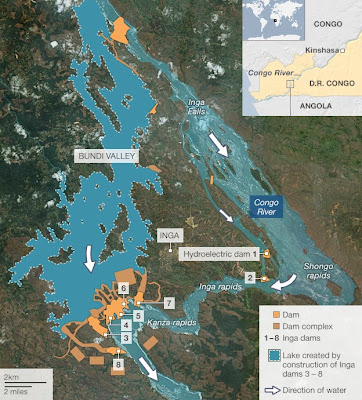
Grand Inga Dam ~ African Congo Hydropower!
 The Congo River has perhaps the greatest untapped hydroelectric potential on the African continent (perhaps even planet-wide), as Guardian environment editor John Vidal noted in 2008...
 "Grand Inga dam in the Democratic Republic of Congo will generate twice as much electricity as the world's current largest dam, the Three Gorges in China, and jump start industrial development on the continent, bringing electricity to hundreds of million of people. But while governments and banks expect the dam to export electricity as far away as South Africa, Nigeria and Egypt, and even Europe and Israel, environment groups and local people warned that it could bypass the most needy and end up as Africa's most ruinous white elephant, consigning one of the poorest countries to mountainous debts. The dam is being planned to exploit one of the largest major water falls by volume anywhere in the world -- nine miles of rapids which lie 90 miles from the mouth of the Congo where the world's second largest river drops nearly 100 metres in just eight miles. Two hydroelectric plants, known as Inga 1 and Inga 2, were constructed near there in the 1970s and a third is planned, but Grand Inga is intended to dwarf them all. One feasibility study suggests the 40,000MW dam will be 150m high, and will harness 26,000 cubic metres of water a second, with more than 50 turbines each producing nearly as much power as a British nuclear reactor. Grand Inga was proposed in the 1980s but never got beyond feasibility studies because of political turmoil in central Africa. But now it stands a chance..."Here's a rendering of the region before and after construction of Grand Inga Dam...
 The larger region within which the Congo River flows...
 There are, of course, severe critics, including the International Rivers folks whose arguments should be considered seriously. And in addition to such huge gigaprojects, there are surely smaller and more distributed clean energy solutions to be deployed in the region, including Small, Micro, and Picohydro. But nevertheless, those 30-50 Grand Inga Gigawatts capacity would be a game-changer.
 P.S. On 14 Nov 2013 the BBC published update report on Grand Inga progress including more details...
19 December 2009
Cosmopolitan Railway ~ Gilpin's Global Vision!
 Thanks to Wikipedia and Google Books for informing me about -- and making possible reading -- William Gilpin's epic futurist work, The Cosmopolitan Railway! An explorer, land speculator, and first territorial governor of Colorado, Gilpin's visionary goal was no less than Compacting and Fusing Together All the World's Continents. Way back in 1890, he was one of the first to envision a land route to Alaska and propose a bridge from America to Russia and Eurasia via the Bering Strait.
23 June 2009
African Rail ~ Ethiopia Invests in Resurgent Ways
 Excellent to read Elizabeth Blunt's piece in the BBC that Ethiopia looks to revive past railway glories. Ethiopia is one of the couple dozen African countries that had rail infrastructure originally built by Europeans back in the day. After decades of war, turmoil, distraction, and neglect, these countries are investing in a railway resurgence. The Ethiopian case is especially interesting -- it being a nascent hydro- and agri-superpower -- and so their plans are suitably ambitious...
 "The government is starting to plan a completely new rail system, with a further 5,000 km (3,100 miles) of lines. It is early days yet [but]this would be a standard gauge railway, electrified to take advantage of the abundant, cheap electricity expected to be produced by ambitious new hydro-electric schemes soon to come into operation. It would be primarily designed to carry freight, and although the proposed routes are still confidential, it might -- for instance -- serve the coffee-producing areas of western Ethiopia, the light industries of the north, the commercial food producing areas south of Addis Ababa, and the fertile, but as yet undeveloped farmlands near the Sudan border."
11 June 2009
African Terabits ~ Undersea Cable Maps
Thanks to White African for spotlighting this African undersea cables-mapping project at Many Possibilities... 
15 May 2009
Ridiculous Infrastructure ~ Stupid Solutions...
I've noticed recently several examples, both new and old, of ridiculous infrastructure projects, in US and beyond, including the Czech "Adriatic Tunnel". The most recent, revealed in the BBC, is A tunnel to unite old rivals? between Bolivia and the Pacific under the border of Peru and Chile. This is because Bolivians still have an axe to grind with Chile having lost a war over a century ago. So instead of moving on -- like Mexico has with US, China has with Russia, Colombia has with Panama, etc -- the Bolivians are thinking of spending orders of magnitude more for what amounts to a rail-and-roadway. But it's a "sovereign street"...Oooooh! I can't believe people are taking a plan like this seriously... 
Subscribe to:
Posts (Atom)


