Showing posts with label Worldmap. Show all posts

23 January 2020

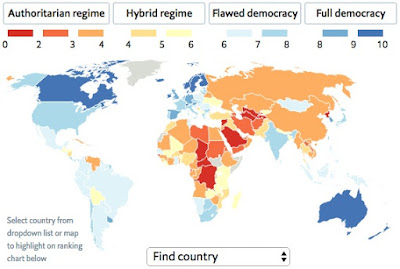
Democracy 2019 ~ Economist Index of World Pox

The Economist says...
"Democracy is in retreat, according to the latest edition of the Democracy Index from our sister company, The Economist Intelligence Unit (EIU). This annual survey, which rates the state of democracy across 167 countries based on five measures -- electoral process and pluralism, the functioning of government, political participation, democratic political culture and civil liberties -- finds that democracy has been eroded around the world in the past year. The global score of 5.44 out of ten is the lowest recorded since the index began in 2006. Just 22 countries, home to 430m people, were deemed “full democracies” by the EIU. More than a third of the world’s population, meanwhile, still live under authoritarian rule."

21 December 2019

Mapping Corruption ~ Transparency to Opacity

Visual Capitalist's Chart of the Week maps Transparency International 2018 data about corruption perceptions worldwide...

22 November 2019

Aridia ~ Towards Oasis Cities in the Drylands?

The WEF writes about Desertification: what is it and why is it one of the greatest threats of our time?
"The combined impact of climate change, land mismanagement and unsustainable freshwater use has seen the world’s water-scarce regions increasingly degraded. This leaves their soils less able to support crops, livestock and wildlife. This week, the Intergovernmental Panel on Climate Change (IPCC) will publish its special report on climate change and land. The report, written by hundreds of scientists and researchers from across the world, dedicates one of its seven chapters solely to the issue of desertification."
The 30 year climate map illustrates the geographies involved (plus see also Koppen climate maps)... In this light, it's worth inverting the issues and seeking opportunities in such drylands.  The big technological achievements of the past half-century are solar power and desalination.  But there's more, including much greater sophistication around water use, shades of greywater, cycling, and design and landscaping for water retention.  Furthermore, reforestation, for instance in the Sahel, has been done with hardier plant varieties and is increasingly including soil modification or assistive techniques to both preserve water and make maximum use of every little bit.  On arid but foggy coasts (e.g. Atacama, Namibia, etc) inexpensive materials are boosting the effectiveness of fog harvesting.  And we can learn from classic desert cities and ancient techniques (e.g. Petra, the medinas, etc) about greening the desert.  In any case, when you stitch all the existing and emergent ideas together, I believe there's a blossoming new category of "oasis cities" in arid regions.

04 November 2019

Desalination Brine ~ Side Effect or Opportunity?

The BBC spotlights Concerns over increase in toxic brine from desalination plants...
"Desalination plants around the world are pumping out far more salt laden brine than previously believed [...] The salty effluent is a by-product of efforts to extract fresh water from the sea. [...] The brine raises the level of salinity and poses a major risk to ocean life and marine ecosystems. [...] There's been a major expansion of desalination plants around the world over the past few years, with almost 16,000 now operating in 177 countries. It's estimated that these plants produce 95 million cubic metres of freshwater per day from seas and rivers -- equivalent to almost half the average flow over Niagara Falls. But the success of the technology is coming at a price. This new study estimates these plants discharge 142 million cubic metres of extremely salty brine every day, a 50% increase on previous estimates."
All challenging and yet therein also lies opportunities, including the mining and refinement of salts, minerals, and metals.

01 June 2019

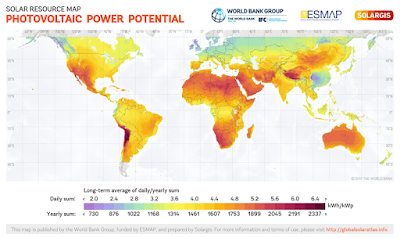
PV Potential ~ Mapping Sunpower Worldwide...

The Sun is a giant thermonuclear reactor in the sky powerbeaming 24x7. A tiny sliver hits the daily rotating Earth and then you have to discount for angles and overcasts. When all's accounted for, here's the resulting worldmap of terrestrial potential for PV or photovoltaic sunpower... Curiously enough, most maps like this only show land incidence. But surely we could float massive solar panels out on swathes of ocean? In fact, perhaps we should hoover up the massive ocean gyres of waste plastic and convert these into floatation for PV paneling.

27 May 2019

Protected Planet ~ Goal of 50% of Earth by 2050

I'm particularly interested in seeing half of Earth be protected by 2050.  Towards this goal, Protected Planet shares the World Database on Protected Areas (WDPA) covering both terrestrial and marine protected areas and tracks progress... The IUCN has a half dozen so-called "Protected Area Management Categories" -- and those are important and worth adding to directly, but I hope we can especially push for enhancement of Category VI "Sustainable Use" with particular eye on private conservancies, land banks, forestry reserves, flood management zones, and potentially even the careful extractions of natural resources. Finally, I hope that we figure out how not to ravage the other half of Earth but rather we green it appropriately (e.g. our cities), share it with nature, and refrain from eco-devastation generally.

14 March 2019

Tectonics in the Tropics ~ Ice Age Triggers!

Jennifer Chu of MIT News spotlights recent research indicating that Tectonics in the Tropics Trigger Earth’s Ice Ages...
"Over the last 540 million years, the Earth has weathered three major ice ages [each] preceded by tropical “arc-continent collisions” -- tectonic pileups that occurred near the Earth’s equator -- in which oceanic plates rode up over continental plates, exposing tens of thousands of kilometers of oceanic rock to a tropical environment.  [The] heat and humidity of the tropics likely triggered a chemical reaction between […] the rocks’ calcium and magnesium […] pulling the [CO2] out of the atmosphere and permanently sequestering it in the form of carbonates such as limestone [cooling] temperatures globally and ultimately [setting] off an ice age."
https://eapsweb.mit.edu/news/2019/tectonics-tropics-trigger-earths-ice-ages-study-finds

18 February 2019

Marine Protected Areas ~ Conserving the Seas

The BBC's Ade Adepitan visits the coast of Gabon which has implemented a substantial Marine Protected Area off its coast. I've been moved by the idea that half of Earth should be set aside in nature protection reserves. That is, half for animal kingdom, half for humanity. Right now, there's a lot more work to be done. Here's the biggest of the MPA's... https://en.wikipedia.org/wiki/Marine_protected_area

08 January 2019

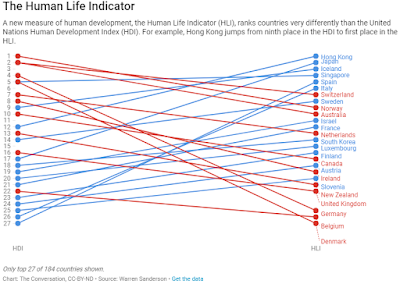
Human Life Indicator (HLI) ~ Alt-Index to HDI...

WEForum shares the Human Life Indicator (HLI) proposed by Sergei Scherbov, Simone Ghislandi, and Warren Sanderson as an alternative measure of development solving several problems of the Human Development Index (HDI)...
"The HDI is like a country’s report card. In a single number, it tells policymakers and citizens how well a country is doing. The HDI has been wildly successful in changing the way people think about the development process. However, it still suffers from real flaws. First, it implicitly assumes trade-offs between its components. The HDI also struggles with the accuracy and meaningfulness of the underlying data. Finally, data on different domains may be highly correlated. The HLI looks at life expectancy at birth, but also takes the inequality in longevity into account. If two countries had the same life expectancy, the country with the higher rate of infant and child deaths would have a lower HLI."
https://www.weforum.org/agenda/2018/11/which-country-is-best-to-live-in-our-calculations-say-it-s-not-norway https://www.weforum.org/agenda/2018/11/which-country-is-best-to-live-in-our-calculations-say-it-s-not-norway

25 December 2018

World Mapping ~ Qualities of Life & Governance...

The Economist's Democracy Index scores 167 countries...
"On a scale of 0 to 10 based on 60 indicators across five broad categories -- electoral process and pluralism, functioning of government, political participation, democratic political culture and civil liberties -- concludes that less than 5% of the world’s population currently lives in a “full democracy”
https://www.economist.com/graphic-detail/2018/01/31/democracy-continues-its-disturbing-retreat?fsrc=scn/fb/te/bl/ed/democracycontinuesitsdisturbingretreatdailychart

12 October 2018

Human Capital Index ~ Developing Youth...

BBC Africa's Farouk Chothia reports on the World Bank's Human Capital Index...
"...a new way of measuring economic success and gauges how much effort is being put into developing the youth. The higher the investment in education and health the more productive and higher earning the workforce tends to be, the World Bank says. African countries dominate the bottom of the index."
https://www.bbc.com/news/live/world-africa-45783166

11 October 2018

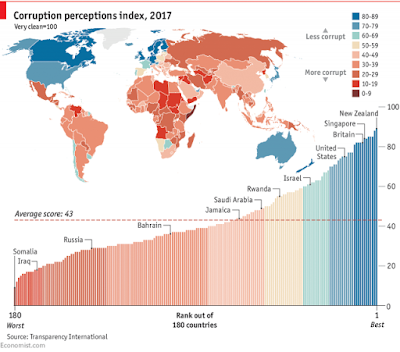
Corruption Perceptions Index ~ Econographic!

The Economist Daily Chart reminds us of Corruption...
"At least 6bn people around the world live in corrupt countries, according to Transparency International’s (TI) latest ranking of perceptions of corruption in the public sector."
https://www.economist.com/graphic-detail/2018/02/22/corruption-is-still-rife-around-the-world?fsrc=scn/fb/te/bl/ed/

19 June 2018

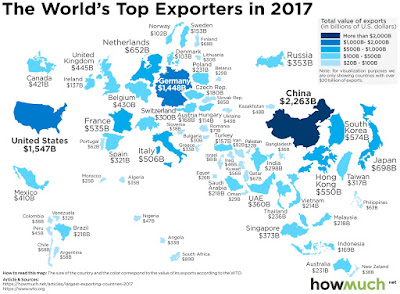
Global Exports ~ Physical Stuff Sold Internationally

HowMuch maps the Global Export Economy in One Map... 
"We got our numbers from the World Trade Organization [...] The WTO tracks the total value of physical goods each country sends across its borders. Remember, these numbers exclude services -- we are only focused on physical items. To create our map, we changed the size of the country depending on the value of exports, and we likewise added a shade of blue for easy reference. This approach highlights the outliers and identifies several key trends."
https://howmuch.net/articles/largest-exporting-countries-2017