"Amino is our first product, a counter-top sized biolab that enables anyone to grow living cells to create new and interesting things - like fragrances, flavours, materials, medicine, and more."

Dive Into the Ghent Altarpiece
4 hours ago
"Amino is our first product, a counter-top sized biolab that enables anyone to grow living cells to create new and interesting things - like fragrances, flavours, materials, medicine, and more."
"Unique concept can provide an unlimited size lagoon, surrounded by picturesque sandy white beaches, anywhere in the world. Their first project, the San Alfonso del Mar tourist complex in Chile, obtained the Guinness World Record for the largest swimming pool in the world, at a size of eight hectares. Crystal Lagoons expects a second Guinness World Record with the 12.5 hectares mega lagoon of the Citystars Sharm El Sheikh tourist complex in the middle of the Egyptian desert. Following that should be a third Guinness Record with the Mohammed Bin Rashid City project in Dubai, expected to be completed by 2020, that includes the world's largest crystalline lagoon with 40 hectares."


"Unlike other 3D printers, using Printeer doesn't require advanced technical or engineering skills. For starters, you don't need to learn CAD (computer aided design) software, a professional-grade tool that is required to generate the 3D designs used by other 3D printers. Printeer design software is different in the following ways: (1) It runs on iPad, a platform most kids are more comfortable with than a PC. (2) It can be learned in about 30 seconds. (3) It doesn't require any intermediate steps between design and 3D printing. No PC, no complex software, no fancy configuration settings. Just touch the "print" button and watch it go."
"MindRider is a new helmet system that shows your levels of engagement (from relaxed to focused), as you move through your environment, in real-time. The MindRider app maps and tracks these levels, and allows you to share your "mind-maps" with others. These maps provide quantified insight that empower you to maximize your riding experience, and they can be a great resource for riding communities and street advocacy."
"[KIBO kits are] specifically designed for young children aged 4-7 years old. It is different from any other kit out there because it appeals to both technically minded kids and those that connect more to arts and culture or physical activity. Young children learn by doing. Children build their own robot with KIBO, program it to do what they want, and decorate it. KIBO gives children the chance to make their ideas physical and tangible -- exactly what their young minds and bodies need. And KIBO does all this without requiring screen time from PCs, tablets or smartphones."Kickstarting now...

"A radically new musical instrument that reimagines the piano keyboard as a soft, continuous surface. [...] The Seaboard’s polyphonic pitch bend, vibrato and per-note dynamic changes are all available at your fingertips, marrying the intuitiveness of a traditional instrument with the versatility of digital technology."
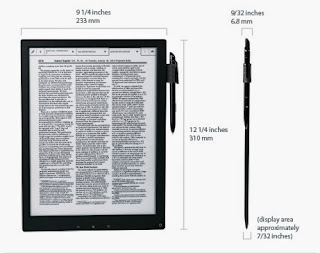
"At $1100 (shipping in May), Digital Paper is being pitched at education, business, and legal environments. Digital Paper appears to only support PDFs, but the website implies that software is included to convert Word, Excel, and PowerPoint files to PDF format. Stylus input appears to be accurate and high-resolution, though e-ink’s refresh latency might cause you some mental discomfort. 4GB of internal storage and a micro SD slot should give you plenty of space for annotating textbooks and documents. At just 357 grams (12.6 ounces), Digital Paper is by far the lightest large-screen tablet on the market, too (the iPad Air is a chunky 469 grams). Hopefully this is the beginning of an exciting, flexible-and-light-weight computing revolution!"
"In the house of the future, wire-free energy transfer could be as easy as wireless internet. If all goes to WiTricity's plans, smartphones will charge in your pocket as you wander around, televisions will flicker with no wires attached, and electric cars will refuel while sitting on the driveway. WiTricity have already demonstrated their ability to power laptops, cell-phones, and TVs by attaching resonator coils to batteries -- and an electric car refueller is reportedly in the works."

"Axis360 is a motion control system that rotates and slides a camera. Axis360 is compact and light weight, sets up easily, and is extremely versatile. It moves at a wide range of speeds, fluidly or incrementally, and works with most DSLR, mirrorless, and cinema cameras."
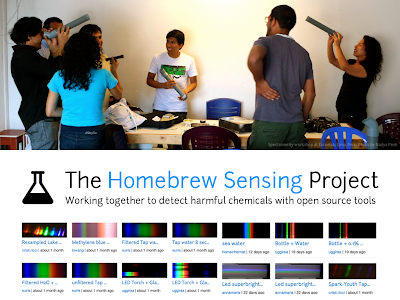
"Just as the Homebrew Computer Club challenged assumptions that computers had no place in the home, the Homebrew Sensing Project explores the potential for spectrometry, a powerful analytic technique for identifying materials, in your home and neighborhood. We have leveraged the emerging Do-It-Yourself movement and the power of open source hardware and software development to bring spectrometric analysis to a new audience -- non-experts investigating and testing their immediate environment. The Homebrew Sensing Project gives everyone access to simple, affordable tools to collect data in their own backyards, providing the information they need to make environmental health decisions."
"It's a kind of robotic hand that looks and feels a lot like a stress ball. Filled with a granular material, in one mode it is squishy enough to envelop an object it's trying to grab. Then, when a vacuum is created inside the ball, the granules get pulled together, solidifying around the object. The unique design enables the gripper to pick up a wide range of different objects, which can weigh up to 20 pounds. Empire has dubbed its product Versaball."
 Anne Eisenberg writes nice story in NYTimes, For the Home Workshop, a GPS for Power Tools, on Alec Rivers and Ilan Moyer's roborouter image-guided powertool based on their MIT research on position-correcting tools with Fredo Durand...
 "As soon as you put the tool on the material, it knows where it is,” Mr. Rivers said. “The screen shows you the path you are on, as well as the pattern you’re going to cut.” When the bit comes within a quarter inch of the pattern, tiny motors in the device go to work, keeping the tool along its correct route. Ilan E. Moyer, a graduate student in mechanical engineering at M.I.T., designed the hardware for the latest prototype of the device. “If you are straying from the path, going to the left,” failing to follow the exact design, he said, “the motors will shift the tool to the right to keep it on the path.” Mr. Rivers said that “all you have to do is get within the ballpark freehand.” Then the “tool GPS” and small-scale computer adjustments guarantee a precise cut."


