
Math Puzzle: A puzzling picture
1 day ago
"At precisely 11:11 a.m. each Veterans Day (Nov. 11), the sun’s rays pass through the ellipses of the five Armed Services pillars to form a perfect solar spotlight over a mosaic of The Great Seal of the United States."
 Let's never forget those who had to fight or stood ready to.
“Decoupling” human economy from ecology could render large areas of pastures, croplands, and managed forests too remote for exploitation. [...] "The way we will save nature is by rendering it economically worthless," declared Ted Nordhaus. Nordhaus, chairman of the Breakthrough Institute, was speaking at "Making Nature Useless," a seminar sponsored by the D.C.-based think tank Resources for the Future. With that one sentence, he summed up the entire session’s theme. [...] "Why are we using just half of the planet's ice-free land surface?" he asked the audience. Cropland only occupies about 12 percent; pasture, 24 percent; managed forests, 9 percent; cities, 3 percent. About 12 percent of the world's ice-free land, he noted, has been formally set aside for conservation and preservation. What makes that 12 percent different? His answer is that, for the most part, it is too high, too dry, too steep, and too remote. We have saved what we have saved, he suggested, largely because it is not worth anything economically. Most of the lands that are not legally protected but remain unexploited share the same economically off-putting characteristics. [...] humanity is on the cusp of "peak farmland." If current land-use trends continue, an enormous amount of crop and pasture land will be abandoned and returned to nature. [...] Urbanization contributes to the process of decoupling economy and ecology, since fewer hungry people engaged in low productivity subsistence farming mean more land for nature. [...] Analysts with old-fashioned Malthusian mindsets are again decrying the imminent approach of "peak everything" followed by a collapse of civilization. The data presented at Wednesday's seminar points toward a much happier version of "peak everything," as humanity increasingly withdraws from the natural world during the rest of this century."


 Two decades ago, extreme violence seized the small but densely populated African nation of Rwanda. Peacekeeping efforts were overwhelmed, the UN and outsiders were slow to act, many, many died. We're still not sure what lessons to draw from the whole experience. But at least it's worth remembering what happened. First, contemporary reports, for example, Nightline Rwanda 1994... Next, retrospective documentaries from a decade ago, including the Ghosts of Rwanda 2004... The overwhelmed UN General Dallaire whose memoir is tellingly titled Shake Hands with the Devil... President Kagame reflects on 20 years... Finally, amidst the craziness of that time emerged several remarkable protectors and heroes. The BBC's Mark Doyle tells of A good man in Rwanda, the Senegalese Captain Mbaye Diagne, a UN observer...
 "This is the story of the bravest man I have ever met. [...] We will never know exactly how many people owe their lives to Mbaye. [He] was part of a small group who had been willing to risk their lives to save others. [Mbaye] had a sense of humanity that went well beyond orders, well beyond any mandate."

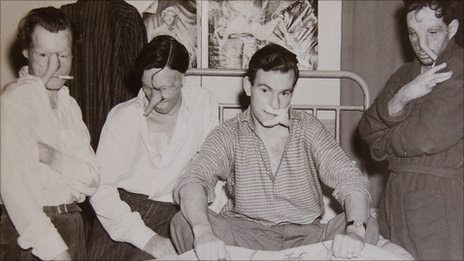
"According to the Guinea Pig Club's honorary secretary, Bob Marchant, who worked with the surgeon in the 1950s, it was his focus on young men's future lives, which paid dividends. "He not only treated them for burns, but also psychologically by getting them back into the community," he said. "There were a lot of wealthy people around here and McIndoe went out and asked them to invite the airmen into their homes. He also did the same in the pubs. "Eventually East Grinstead became known as the town that didn't stare."
 Amazing and holistic healing innovations... Finally, 60 Minutes catches up with two Australian "Guinea Pigs" who met during recovery and are still best mates after all these years!
"When a global effort to end polio was launched in 1988, the disease crippled more than 200,000 children every year in India. Almost two decades later, in 2009, India still reported half of the world's new cases -- 741 out of 1,604. India has millions of poor and uneducated people. The population is booming. Large areas lack hygiene and good sanitation, and polio spreads through contaminated water. Many health experts predicted India would be the last country in the world to get rid of polio. They were wrong."
"If you want to see the challenges small food entrepreneurs face on a daily basis -- with long hours of hard work as their only guarantee -- then you’ll love Dog Days. [The Directors say...] we began shooting when there were only a few food trucks on the scene, and we loved Coite’s idea of bringing new food to the streets, but working with existing vendors. We also felt like there was a largely untold story there about an immigrant population of vendors that have been selling food on the streets of DC for over 20 years. [...] We wanted to capture the immigrant story in the film because it’s a community that can easily be overlooked in the course of day-to-day life."
 MIT Media Lab Professor Hugh Herr writes in the WSJournal about Bionics and the Boston Bombing Victims and introduces No Barriers Boston initiative to provide the injured with sport-ready prosthetics...
 "Dance teacher Adrianne Haslet-Davis, who suffered a below-the-knee amputation as a result of the Boston bombings, vows to dance again and to run in next year’s Boston Marathon. [...] I believe Adrianne will succeed. She has the will, which is essential. [Beyond this...] technology will be paramount to Adrianne’s participation in the Marathon next year. It will also shape the rest of her life. [...] To help those injured in the Boston bombings, my research group at the MIT Media Lab is collaborating with a nonprofit, No Barriers, which is establishing a No Barriers Boston Fund. The fund will provide individuals with prosthetic limbs specifically designed for athletic activities [...] Adrianne will successfully run in next year’s Boston Marathon. And that she will dance. When she runs the marathon next year, I will join her, along with other athletes using artificial limbs and wheelchairs. We will participate as a beautifully defiant statement to the world that we the people will not be intimidated, brought down, diminished, conquered or stopped by acts of violence."Yes, indeed.
"While the record-breaking event is what drives the film’s narrative arc, it is the everyday stories of the young kite makers that will touch audiences through their humor and playful spirit. The film seeks to humanize the conflict through a touching cinematic rendering of the fascinating kite culture among children as a form of creative resistance in Gaza."
"Around the world, countless millions suffer with diseases that could be easily cured if those patients could reach modern medical care. For a fortunate few, there is a lifeline called "Africa Mercy." She is the largest civilian hospital ship on the seas."
 CNN's Mairi Mackay profiles Gene Sharp: A dictator's worst nightmare!
"He's been called the father of nonviolent struggle. He could be also described as a revolutionary's best friend. Or perhaps, more accurately, as a dictatorship's worst nightmare. Now 84, the American academic has dedicated most of his life to the study of the bold, some might say reckless, idea that nonviolence -- rather than violence -- is the most effective way of overthrowing corrupt, repressive regimes. [...] His practical manual on how to overthrow dictatorships, "From Dictatorship to Democracy," has spread like a virus since he wrote it 20 years ago and has been translated by activists into more than 30 languages. He has also listed "198 Methods of Nonviolent Action" -- powerful, sometimes surprising, ways to tear power from the hands of regimes. [...] His ideas of revolution are based on an elegantly simple premise: No regime, not even the most brutally authoritarian, can survive without the support of its people. So, Sharp proposes, take it away. Nonviolent action, he says, can eat away at a regime's pillars of power like termites in a tree. Eventually, the whole thing collapses. For a half century, Sharp has refined the theory of nonviolent conflict and crafted the tools of his trade. His methods have liberated millions from tyranny -- and that makes regimes from Myanmar to Iran quake in their boots."See here trailer for How to Start a Revolution...
"...uplifting story of resilient Palestinian youth in the Gaza Strip on a quest to shatter the Guinness World Record for the most kites ever flown. [...They] capture the culture of kite making and flying among youth and their spectacular record-breaking event."I've seen the rough-cuts and this is essential and inspiring material!


