
Dive Into the Ghent Altarpiece
4 hours ago


 Here we have two more examples, first the spread of Islam...
  And the spread of Buddhism...
  Yes, these happen on different timescales, have diverse points of origin, and varied mechanisms for transmission + replication + mutation. Nevertheless both poisonous ideas and viral poisons are parallel phenomena for humanity to apply scientific methods on, to ever more thoroughly understand, and to ultimately prevail over.
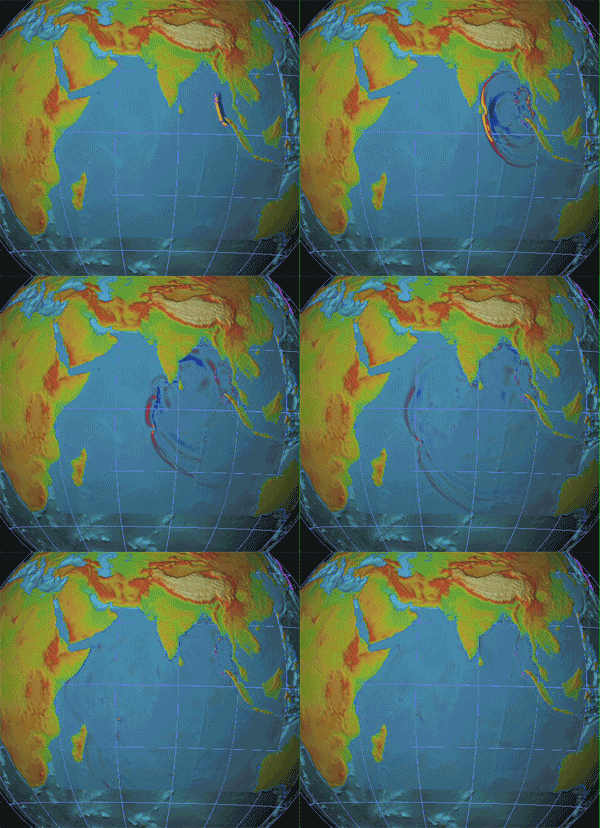 Second, look at this seismographic plot from around the world showing the Earth literally ringing from the rupture of the Sunda megathrust off the coast of Sumatra, Indonesia...
"The GlobalHealth Lab gives students a unique opportunity to work on the front lines of health delivery on-site in Sub-Saharan Africa and Asia, cumulatively over 50+ Projects in 13 Countries since 2008 with more than 40 host organizations, including clinics, hospitals, startups and non-profits."
"Our core mission is to bring innovative energy solutions to people around the world. We began this quest working with rural Himalayan families to help find a solution to meet their energy needs. Five years and thirteen prototypes later, we’ve created a product that people love and significantly improves their quality of life. Right now, many families rely on SolSource for their daily cooking needs. SolSource saves them time and money, reduces their exposure to harmful stove pollution, and preserves the environment."
 Fantastic to have final presentations this morning in our emerging market innovations class, MIT Development Ventures! 2011 is the 11th year Professor Alex (Sandy) Pentland and I have run this entrepreneurial action lab! Nearly three- dozen new venture concepts this year, including both for- and non-profit, across multiple sectors including health, energy, education, commerce, and civic. In reverse order of presentation, we have (plus start geo-locations)...
 Fascinating to read Russia's Vladimir Putin's proposed New integration project for Eurasia: The future in the making...
 "The road to this milestone was difficult and often torturous. It began two decades ago when the Commonwealth of Independent States was established after the Soviet Union’s collapse. To all intents and purposes, the selected model helped preserve the myriad of ties, both of civilisation and culture, which unite our peoples and also forged links in production, the economy and in other vital areas essential for our lives. There are different views on how efficient the CIS is, and disputes over its internal problems and failed hopes have the potential to run and run. But it is difficult to argue with the fact that the commonwealth remains an irreplaceable mechanism that helps bring our positions closer together and enables us to elaborate a common view on key issues facing our region, in addition to the tangible benefits it affords its members. Moreover, the CIS experience enabled us to launch a many-tiered, multi-speed integration process in the post-Soviet space..."Beyond Belarus, Kazakhstan, and the smaller Stans, this emergent new Eurasian Commonwealth could successfully engage Mongolia, Turkey, Scandinavia, Korea, and Japan in a transformative new kind of polity, one as resourceful and industrious and heavy-weight as India and China. Very exciting!
 I've long been fascinated by Vladivostok, the premier port city of Russia's Far East in the Primorsky Krai province. Together with nearby Nakhodka, this terminus of the Trans-Siberian Railway is the key Eurasian translogistics node linking Russia
  and east Asian neighbors, the Koreas, Japan, northeast China, and beyond. Beautifully situated at the southern tip of the Muravyov-Amursky Peninsula, Vladivostok is extraordinarily well-positioned to become something akin to an easterly Saint Petersburg and northerly Hong Kong. Indeed, the latest developments include building an epic bridge southward to the just-offshore Russky Island and preparing the site for the APEC 2012 Summit and subsequent use as campus by FENU, the strategically expanding Far Eastern Federal University...
  Russky Island was a closed military zone in Soviet times, but with these latest developments -- plus prospective investments and wise leadership -- it is poised to help greater-Vladivostok become an educational and tourist zone and prospectively a new technological innovation epicenter -- much like the Boston-metro Hub is and as Skolkovo near Moscow aspires to be. For background, see here RT's 2007 report Russia Close-Up: Primorsky's forgotten island... And definitely check out this really epic-bridge building video!
 Matthias Schepp writes in Der Spiegel about Change in Russia's Far East: China's Growing Interests in Siberia...
 "There are just 6 million Russians left on the Siberian side of the border with China. Ninety million Chinese, backed by a voracious economy, live on the other side. China's influence in Russia's far east is growing rapidly and Siberia has become the raw material supplier to Beijing's economic miracle. [...] Could an alliance develop in this region between two powerful countries that would finally put an end to American dominance of the world? One of the two has the raw materials that the other one needs so urgently. Or will the land of Vladimir Putin become a bulwark against an increasingly self-confident China, and thus become the natural partner of the West? Or will neither of these scenarios come to pass, when overpopulated China simply swallows up depopulated Siberia? [...] Forgotten by the Kremlin? Siberia, which covers three-quarters of the landmass of Russia, is home to only a quarter of the country's population: 38 million people. This is the equivalent of the population of Poland, except that Siberia is 40 times the size. It is a situation that many fear could once again spark the eternal rivalry between Russia and China, a rivalry that last produced military clashes in the 1960s."Surely the Russians can figure out how to profitize their incredible advantages as an asset-rich Eurasian bridgeway to Asia?

"Trains magazine Senior Editor Matt Van Hattem's April 2011 story, "Fast Times in Asia," [shared] his experiences on high speed trains in China, Korea, and Taiwan. Check out some video of what he saw on his Asian high speed rail trip."

 But no. In the latest NYTimes, Martin Fackler writes In Japan, Young Face Generational Roadblocks and spotlights Kenichi Horie...
 "...a promising auto engineer, exactly the sort of youthful talent Japan needs to maintain its edge over hungry Korean and Chinese rivals. [...] But like many young Japanese, he was a so-called irregular worker, kept on a temporary staff contract with little of the job security and half the salary of the “regular” employees, most of them workers in their late 40s or older. After more than a decade of trying to gain regular status, Mr. Horie finally quit -- not just the temporary jobs, but Japan altogether. He moved to Taiwan two years ago to study Chinese. “Japanese companies are wasting the young generations to protect older workers,” said Mr. Horie, now 36. “In Japan, they closed the doors on me. In Taiwan, they tell me I have a perfect résumé.”Where else might the Wo Kiu go?
 Thanks to Dark Roasted Blend for interviewing Robert Kunzig, Senior Environment Editor of my favorite monthly magazine, National Geographic, about their 7 Billion article (with beautiful January cover and other photos by Randy Olson) and the year-long series on human population. Among the nuggets...
 On Consumption -- "The point is not to reduce consumption per se, because consumption is not evil per se -- it's important not to get moralistic about these issues, if only because moralism is self-defeating. The point is to reduce the damage that certain kinds of consumption cause. If we can find a cheap way to tap limitless solar energy, would it matter if our energy consumption continued to rise? Not so much, except in deserts covered by solar panels." On Sprawl -- "It already is happening differently -- baby boomers are getting old and realizing they don't want to be trapped in the suburbs, and their children, now grown, aren't having as many babies and finding they like the city, etc etc. One of the biggest challenges we face these days is overcoming our built legacy of car-centered sprawl. And one of the big challenges for Asia will be to try to avoid the worst excesses of a particular time and place that they don't have to make their own." On Education -- "She was clear about one thing -- if her son didn't get a scholarship to go to engineering college, she and her husband were going to find the money to pay for it. Around the corner, in another tiny living room, I met a father who had the same ambition for his two teen-age girls. Indians spend a huge portion of their budget on education. And kids on average are much more educated than their parents. There is way too much poverty and hunger in India. Things would be much easier if there weren't so many people. But it is a country with a lot of hope."
 Thanks to Grant Ho for spotting this WSJournal essay by Amy Chua on Why Chinese Mothers Are Superior. Chua is a Yale Law Professor and author of "Day of Empire" and "World on Fire" and, most recently, a memoir "Battle Hymn of the Tiger Mother" wherein she writes...
 "A lot of people wonder how Chinese parents raise such stereotypically successful kids. They wonder what these parents do to produce so many math whizzes and music prodigies, what it's like inside the family, and whether they could do it too. Well, I can tell them, because I've done it. [...] Despite our squeamishness about cultural stereotypes, there are tons of studies out there showing marked and quantifiable differences between Chinese and Westerners when it comes to parenting. [...] What Chinese parents understand is that nothing is fun until you're good at it. To get good at anything you have to work, and children on their own never want to work, which is why it is crucial to override their preferences. This often requires fortitude on the part of the parents because the child will resist; things are always hardest at the beginning, which is where Western parents tend to give up. But if done properly, the Chinese strategy produces a virtuous circle. Tenacious practice, practice, practice is crucial for excellence. [...] Western parents try to respect their children's individuality, encouraging them to pursue their true passions, supporting their choices, and providing positive reinforcement and a nurturing environment. By contrast, the Chinese believe that the best way to protect their children is by preparing them for the future, letting them see what they're capable of, and arming them with skills, work habits and inner confidence that no one can ever take away."Definitely read the whole thing, plus see related video...
"...microloans have prompted political hostility in Bangladesh, India, NicaraguaLet's hope extortionist neo-socialist politicians don't screw things up even further.and other developing countries. In December, the prime minister of Bangladesh, Sheik Hasina Wazed, who had championed microloans alongside President Clinton at talks in Washington in 1997, turned her back on them. She said microlenders were “sucking blood from the poor in the name of poverty alleviation,” and she ordered an investigation into Grameen Bank, which had pioneered microcredit and, with its founder, was awarded the Nobel Peace Prize in 2006. Here in India, until recently home to the world’s fastest-growing microcredit businesses, lending has slowed sharply since the state with the most microloans adopted a strict law restricting lending. In Nicaragua, Pakistan and Bolivia, activists and politicians have urged borrowers not to repay their loans. The hostility toward microfinance is a sharp reversal from the praise and good will that politicians, social workers and bankers showered on the sector in the last decade."


