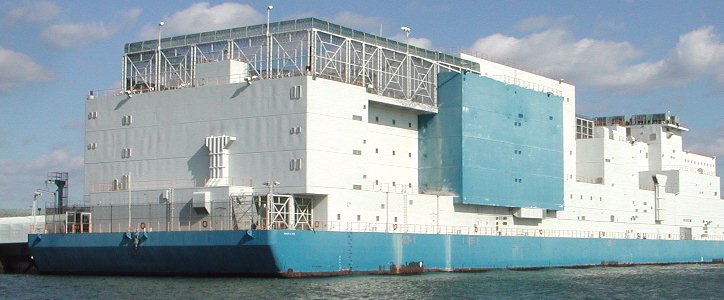
"A new modular medium speed engine power barge design [...] This radiator-cooled modular power barge design permits the same hull to be utilized with a range of power outputs from 80 MW to 180 MW. [...] The new design is presently being modified for dual fuel and natural gas operations to suit combined operations with LNG […] and combined cycle systems for specific market opportunities."
Power barges are the fastest way to ramp up electricity (and cogen + water desal) infrastructure in coastal or navigable river areas. By floating in and being modular, they can be incrementally added to (with more barges) or floated out and moved to new or better location (and/or refurbished). See also my previous posts on this topic!
One of the latest beneficiaries of the Mercy Ships floating hospital organization (and one of my favorite examples of flexible & fast floating solutions) is Sambany, a 55yo burdened by an 8kg facial tumor. Not only is his treatment story epic, but so too is the essential life-affirming mission of MS... See more on the MS channel.
"The Chosen Vessel, run by NGO Project Amazonas, provides medical services to the remote villages of the Peruvian Amazon. There is an on-board doctor and dentist, and free reading glasses are given to those who need them. The boat hospital has treated 200,000 people in the 16 years it has been sailing on the river."
In addition to the supreme lack-wisdom that lead NYC hospital designers to place emergency generators in basements (e.g. NYU Langone), other examples include tunnel owner-operators neglecting to deploy emergency closure mechanisms at a compelling scale. So check out the Tunnel Plug that Mike Ahlers spotlights in his CNN piece Huge plugs could have spared subways from flooding...
"Huge inflatable plugs -- now being developed by the federal government to protect subway tunnels from terrorist attacks -- likely could have saved some of New York's subway tunnels from storm-related flooding, according to plug developers, some of whom are wistful that development wasn't completed in time for Hurricane Sandy. [...] The plug -- simple in theory, but sophisticated in design -- inflates like a balloon to fit the contours of a tunnel, and can reduce leakage to amounts manageable by pumps. Placed on either end of some of the tunnels under New York's East River, the plugs could have prevented flooding, team members told CNN. But plugs would not have prevented water from infiltrating porous underground subway stations and other infrastructure, they said."
I've written before about the hospital ship African Mercy, and Shell's Prelude FLNG, NYC's prison barge, and even the Blueseed visa-free startup ship -- which are all great examples of flexible, floating infrastructure. Thanks now to UD for spotting the Logos Hope...
"...the world’s largest floating bookstores. The Logos Hope is operated by a German charity organization, and its mission is to take books, education, and community outreach around the world. [...] Part of the ship’s mission is to make low-cost books available in parts of the world where books are hard to come by–this includes not only selling books below retail prices, but also establishing libraries in local schools, children’s homes, and other community organization wherever the Logos Hope sails. In addition to book-distribution, the Logos Hope hosts educational programming about fitness, AIDS prevention, and a variety of other subjects. Since it set sail in 2004, the Logos Hope has distributed more than 3 million books and had more than 2.5 million visitors onboard."
"...engaged in the development and commercialization of technology for marine transportation of compressed natural gas (CNG) [They do this through a] innovative marine CNG technology -- the Coselle. The Coselle is a large-volume, high-pressure gas storage module. Coselle is a contraction of the words “coiled pipe in a carousel”. [The result is] efficient transportation of CNG by ship with a minimal onshore footprint [and] a highly economic solution for realizing the potential of many unexploited or underexploited natural gas reserves."
This is a big deal in that it enables shuttling gas from smaller supply points and/or in places where capital infrastructure is too challenging...
"While the energy density of CNG is about half that of LNG and will therefore require more shipping capacity, CNG loading and discharge facilities are much simpler, much less expensive and have a significantly smaller footprint. The result is that CNG provides a significantly more economic solution, which is easier and quicker to permit and implement, for the transportation of smaller volumes of gas over shorter distances."
This is a brilliant scheme which will be tremendously valuable, especially in emerging markets with fast growing coastal activities and where economies of flexibility are key. This finale video summarizes the basic Sea NG shuttle transportation service for CNG... P.S. There are other approaches to shipping CNG.
"...two 300' x 100' barges, each equipped with GE 7FA turbines, that have a combined power generating capacity in excess of 340 MW of electricity. [...] launched in 180 days. Waller Marine designed and managed the construction of the barges, along with the installation of the power plants on the barges, utilizing over 900 men working in shifts, 7 days a week, 24 hours a day. This video shows the highlights and progress of the construction, the launch of the barges and their subsequent movement by tug and heavy lift vessel."
"...world’s first FLNG [Floating Liquified Natural Gas] facility [and] world’s largest floating object ever constructed [...] From bow to stern, the Prelude FLNG measures 488 meters long (that’s more than 1,600 feet) and 74m wide That’s longer than 4 football fields laid end-to-end, including end zones. That dwarfs the massive Emma Maersk by 300 ft and even the late Knock Nevis supertanker by nearly 100 ft."
What I especially like about this is it's the most sophisticated example yet of "containerized infrastructure" which offer economies of flexibility and even urgency -- i.e. many examples are standard shipping container-based, whereas others -- such as the Shell Prelude -- are floating superstructures, e.g. power plants, hospital ships, even prisons! Amazing in scale and ambition!
Writing about Mercy Ships got me thinking again about floating power plants and that in turn got me thinking about other urgent solutions which can be deployed relatively rapidly -- and moved easily. Last summer at MIT's IDDS, Jock Brandis proposed a containerized Jatropha-to-biodiesel plantoleum processing facility. It turns out a quickie search shows several players making such turnkey systems. But the idea of containerized infrastructure extends to many things:
And more. This is a theme I'm paying close attention to and will revisit here time to time. Please drop a line if you find examples of interest or have something compelling to add.
It has me wondering about other potential offshore development opportunities. One thought in the article particularly struck me: it was the comment about augmenting land-scarce cities like NY with services they need. Why not build condos -- even communities -- near-shore? Or office buildings? People love the water, the view and proximity to the city. This is a viable solution to a real estate crunch. Think South East Asia. Plus, there is already ferry service in the Boston Harbor, in NYC, and SF. People vaction on house boats, take cruises, and travel to islands ... why not live there!
Indeed, said I, pointing out that the powers that be -- brighter minds than ours -- are already on it! Check out these multi-million dollar accomodations moored off New York City. Hundreds of people already live there... Seriously, though, this is a damn great idea. Floatable stuff is fast: fast to install, fast to change, fast to improve, fast to remove. All excellent qualities, worldwide.
Reading about the challenges in South Africa, with ESKOM not generating enough, or Liberia, with devastated infrastructure, it seems that surely floating power plant solutions would allow for rapid infrastructure deployment. There's a bit of precedent with Waller-Marine's designs, including this 220 MW power barge... The Russians are proposing floating nuclear plants...
MIT $100K Entrepreneurship Competition, Enterprise Forum Global, Enterprise Forum of Cambridge, Muddy Charles Pub, African Business Club, Sloan Entrepreneurs for International Development, Global Startup Workshop, Sustainability@MIT, TechLink, Making Progress, HighTechFever.tv, MIT Innovation Tours