Showing posts with label Economist. Show all posts

23 January 2020

Democracy 2019 ~ Economist Index of World Pox

The Economist says...
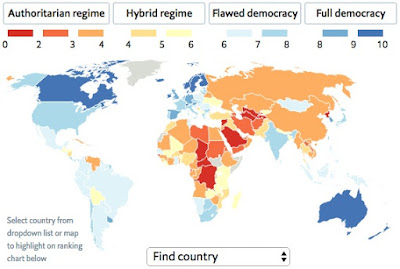
"Democracy is in retreat, according to the latest edition of the Democracy Index from our sister company, The Economist Intelligence Unit (EIU). This annual survey, which rates the state of democracy across 167 countries based on five measures -- electoral process and pluralism, the functioning of government, political participation, democratic political culture and civil liberties -- finds that democracy has been eroded around the world in the past year. The global score of 5.44 out of ten is the lowest recorded since the index began in 2006. Just 22 countries, home to 430m people, were deemed “full democracies” by the EIU. More than a third of the world’s population, meanwhile, still live under authoritarian rule."

05 January 2020

Losing Faith ~ Shifts in Religous Zeal Appeal

The Economist spotlights Arab Barometer religious trendscape...
"NO TO RELIGION or sect,” cry the protesters in Iraq. “No to Islam, no to Christianity, revolt for the nation,” echo those in Lebanon. Across the Arab world people are turning against religious political parties and the clerics who helped bring them to power. Many appear to be giving up on Islam, too. These trends are reflected in new data from Arab Barometer, a pollster that surveys Arab countries. Across the region the share of people expressing much trust in political parties, most of which have a religious tint, has fallen by well over a third since 2011, to 15%. (The share of Iraqis who say they do not trust parties at all rose from 51% to 78%.) The decline in trust for Islamist parties is similarly dramatic, falling from 35% in 2013, when the question was first widely asked, to 20% in 2018."

25 December 2018

World Mapping ~ Qualities of Life & Governance...

The Economist's Democracy Index scores 167 countries...
"On a scale of 0 to 10 based on 60 indicators across five broad categories -- electoral process and pluralism, functioning of government, political participation, democratic political culture and civil liberties -- concludes that less than 5% of the world’s population currently lives in a “full democracy”
https://www.economist.com/graphic-detail/2018/01/31/democracy-continues-its-disturbing-retreat?fsrc=scn/fb/te/bl/ed/democracycontinuesitsdisturbingretreatdailychart

11 October 2018

Corruption Perceptions Index ~ Econographic!

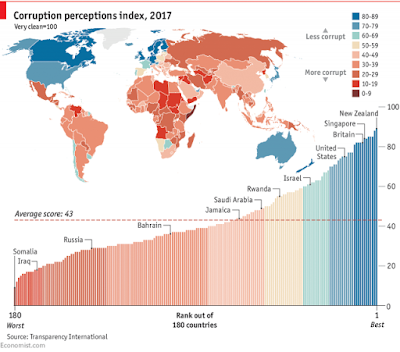
The Economist Daily Chart reminds us of Corruption...
"At least 6bn people around the world live in corrupt countries, according to Transparency International’s (TI) latest ranking of perceptions of corruption in the public sector."
https://www.economist.com/graphic-detail/2018/02/22/corruption-is-still-rife-around-the-world?fsrc=scn/fb/te/bl/ed/

05 November 2016

Gender Inequality ~ Global Gov't Leader Map...

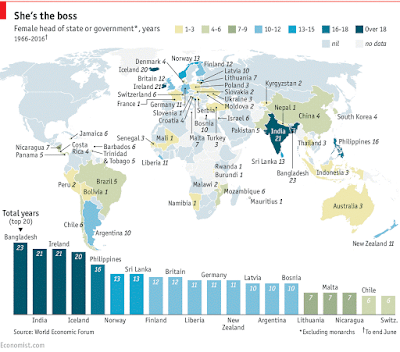
The Economist's Daily Chart spotlights how Gender inequality goes right to the top...
"Around the world, women rarely get the top job. The World Economic Forum, a think-tank, has tallied data on women in power in 144 countries for the past 50 years. During that time period, just under two-fifths of the countries surveyed had a female head of state or government at some point for at least a year (excluding monarchs). In half of those countries, the total time served by female leaders falls short of five years, a common length of a single full term in office."
http://www.economist.com/blogs/graphicdetail/2016/11/daily-chart?fsrc=scn/fb/te/bl/ed/

31 July 2016

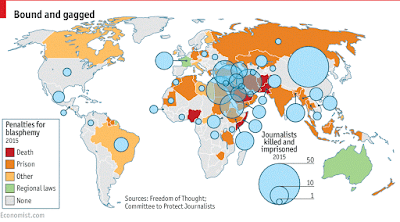
Muzzled Mouthes ~ Free Speech Under Siege...

The Economist spotlights The muzzle grows tighter on the scourge of anti-liberty cultural, religious, and legal muzzling of free speech. Vile governments, religious wingnuts of all flavors, authoritarian or conservative movements -- all evil and spreading... http://www.economist.com/news/international/21699906-freedom-speech-retreat-muzzle-grows-tighter

21 April 2015

Tech Sector ~ Charting Market Value over Time...

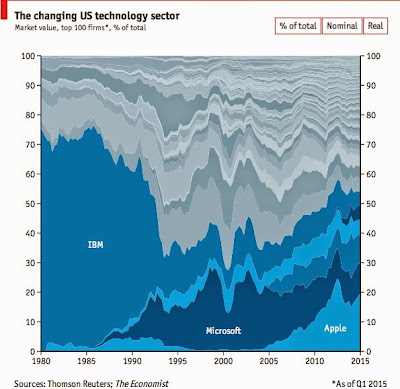
The Economist's Dailychart‬ shows the changing shape of the US technology sector...
"Founded in 1911 as a manufacturer of punch-card machines, more than a century later IBM remains one of the largest technology companies in the world. But the days of Big Blue’s dominance are long past. It was recently surpassed in market value by Facebook, a company barely a decade old..."
http://econ.st/1QfdNNp

04 February 2015

Urbanization Map ~ Charting Rise of Megacities...

The Economist Daily Chart spotlights the Rise of the Megacity...
"By 2030 nearly 9% of the world's population will be living in just 41 megacities (those with more than 10m inhabitants), according to the UN. London earned megacity status in 2013 and Asia will account for over half of the world's 29 megacities in 2015. By 2030 Lagos in Nigeria, Africa's most populous city, is forecasted to have over 24m residents."
http://www.economist.com/node/21642053?fsrc=scn/fb/wl/bl/dc/dailychart

17 November 2014

The Pacific Age? ~ Economist Special Report...

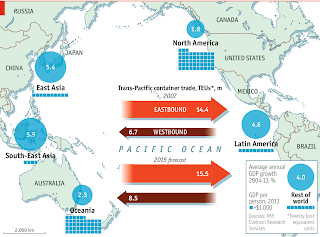
The Economist surveys The Pacific Age including the dramatic re-emergence of Asian economies and related trade with the Americas...
"The refrain, “The Mediterranean is the ocean of the past, the Atlantic is the ocean of the present and the Pacific is the ocean of the future,” first heard more than 100 years ago, is still repeated today. Yet exactly half a century after Japan “rejoined the world” (in the phrase of Ian Buruma, a writer) by hosting the Olympics in 1964, the Pacific Age has now clearly arrived. Japan’s economic power may have peaked 25 years ago, but it produced a trans-Pacific competition that now has America and China vying with each other for the title of the world’s largest economy (at purchasing-power parity). All three Pacific nations trade vigorously with one another."
http://www.economist.com/news/special-report/21631795-under-american-leadership-pacific-has-become-engine-room-world-trade

18 January 2014

Junkyard Planet ~ Global Trash Trading...

The Economist reviews Adam Minter's Junkyard Planet which surveys the emergence of value-from-waste ventures globally...
"The multibillion-dollar recycling trade stands as “one of globalisation’s great, green successes”, writes Adam Minter, an American journalist, in "Junkyard Planet".
http://shanghaiscrap.com/books/junkyard-planet/
It is also a largely unsung one, as under-appreciated as a rusty bike. The industry turns over as much as $500 billion annually, and employs a huge number of people. [...] Dirty, dangerous, cheap to get into and not without romance, the junk business extracts value from what others see as worthless. Mr Minter is not blind to the grim realities of the industry. [...] But any recrimination over these recycling practices is best directed at the rich world and at the increasingly wealthy Chinese who are beginning to match their wasteful, spendthrift counterparts in the West. The recycling industry squeezes value from used goods, but nothing is 100% recyclable."
See excerpt at Shanghai Scrap, Minter's blog!

17 November 2013

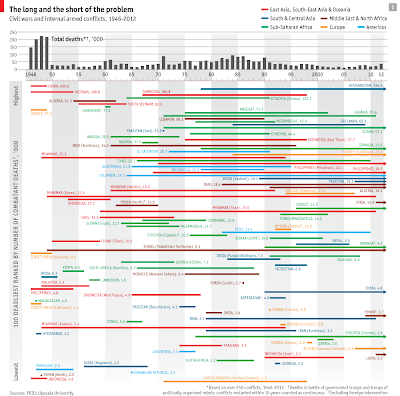
Civil Wars ~ Economist on Ending Conflicts...

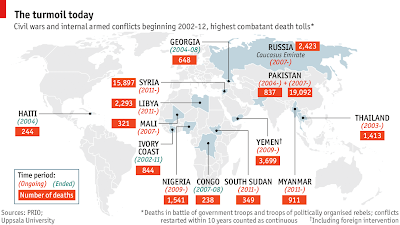
http://www.economist.com/news/briefing/21589431-bringing-end-conflicts-within-states-vexatious-history-provides-guide?zid=312&ah=da4ed4425e74339883d473adf5773841The Economist reveals about Civil Wars, How to stop the fighting, sometimes...
"Ending civil wars is hard. Hatreds within countries often run far deeper than between them. The fighting rarely sticks to battlefields, as it can do between states. Civilians are rarely spared. And there are no borders to fall back behind. [...] Yet civil wars do end. Of 150 large intrastate wars since 1945 fewer than ten are ongoing. Angola, Chad, Sri Lanka and other places long known for bloodletting are now at peace, though hardly democratic. And recently civil wars have been ending sooner. [...] So far, nothing has done more to end the world’s hot little wars than winding up its big cold one. [...] More conflicts ended in the 15 years after the fall of the Berlin Wall than in the preceding half-century [...] Until 1989, victory for one side was common (58%). Nowadays victories are much rarer (13%), though not unknown [...] The main reason for jaw-jaw outpacing war-war is a change in the nature of outside involvement. In the Cold War neither of the superpowers was keen to back down; both would frequently fund their faction for as long as it took. Today outside backers are less likely to have the resources for such commitment. And in many cases, outsiders are taking an active interest in stopping civil wars. [But] the motives vary."
http://www.economist.com/news/briefing/21589431-bringing-end-conflicts-within-states-vexatious-history-provides-guide?zid=312&ah=da4ed4425e74339883d473adf5773841

28 April 2013

Future Africa ~ Economist's Ledgard on Afrotech

Join us this Monday, April 29, 2013 at 1pm at MIT Media Lab E14-633 6th floor lecture hall for Future Africa talk by Jonathan Ledgard, Director of Afrotech initiative at EPFL & Africa Correspondent at Large for The Economist. Ledgard will spotlight the technology choices Africa makes in the next decade will help determine whether it becomes competitive or unmanageable. This informal talk will overview Africa's security and environmental challenges, underline its economic potential, and get beyond ICT to identify areas where science will be decisive. He is director of the Afrotech initiative at EPFL in Switzerland. Afrotech seeks to pioneer massively scaleable high technologies into and out of Africa, including distribution of advanced knowledge on digital platforms, robotics, solar, and complexity thinking for future cities. Prior to joining EPFL Jonathan was a foreign political and war correspondent for The Economist. He joined the newspaper in 1995. Since 2004 he has been East Africa correspondent for the paper, with a reporting focus on risk and technology issues. He has published two novels, Giraffe (2006) and Submergence (2012).