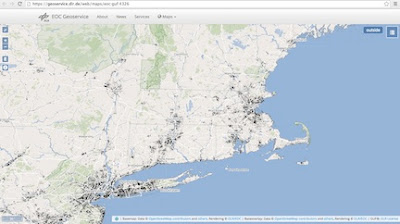
"What’s needed is a way of mapping urban areas from space at high resolution and in a way that is unaffected by cloud cover and without the ambiguities that traditional imaging introduces. [Now revealed is] a global map of urbanization that meets all these requirements. The result is a data set of the entire planet at a resolution of 12 meters that maps the global urban footprint with unprecedented accuracy and resolution. [...] Esch and co have created a global database of built-up areas based on synthetic aperture radar images from an Earth-orbiting mission called TanDEM-X. This consists of a pair of spacecraft that have been orbiting Earth in close formation -- just a few hundred meters apart -- since 2007. These spacecraft take radar images of the ground from slightly different angles, allowing researchers to create a 3-D map of the planet. In total, Esch and co have processed 470,000 pairs of images to create their map of the entire planet."
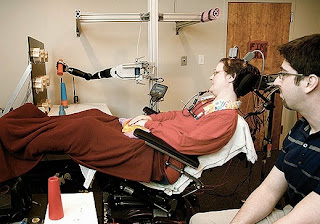
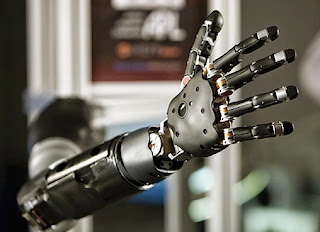
"In a remarkable study, a paralyzed woman used her mind to control a robotic arm. If only there were a realistic way to get this technology out of the lab and into real life. [...] She couldn’t believe she’d had voluntary brain surgery. “I thought, Please, God, don’t let this be for nothing. My greatest fear was that it wouldn’t work,” she says. But within days, she was controlling the robotic arm, and with unexpected success: “I was moving something in my environment for the first time in years. It was gasp-inducing and exciting. The researchers couldn’t wipe the smile off their faces for weeks either.”
"Kendall has become what economists call a cluster, a concentration of interconnected companies that both compete and collaborate. [...] net job growth comes from startup companies, especially the kind that explode from a few employees to several thousand. In technology, those winners have a way of producing more winners. The process reaches critical mass in the web of intertwined companies, resources, advantages, ideas, talent, opportunity, and serendipity that defines a technology cluster. It’s clear that what’s essential is proximity to human talent and new ideas. [...] The big questions in this month’s MIT Technology Review Business Report are why technology clusters arise and what the ingredients are to create one."
"The EIA report concludes that Russia has even more technically recoverable shale oil than the United States. Three countries have more shale gas—China, Argentina, and Algeria. Geologists have long known that some shale deposits contain large amounts of oil and gas, but it’s only recently that hydraulic fracturing and horizontal drilling technology have made it feasible to extract."
"Gold electrodes and wires just a few hundred nanometers thick are deposited on silicon wafers by conventional means, then peeled off and applied to stretchable polymers. The serpentine wires elongate when the polymers stretch, either when the balloon inflates in the heart or as the patch moves around on the skin. The electrodes measure electrical impedance to detect the electrical signals in cardiac tissue or moisture levels in the skin. The company is building on lab prototypes made by University of Illinois materials scientist John Rogers, a company cofounder. [...] In addition to its hydration patch, it is working on patches that use sensors to detect heartbeat, respiration, motion, temperature, blood oxygenation, and combinations of these indicators. MC10's skin patches can wirelessly transmit information to a nearby smartphone."
"...researchers from Columbia University [...] used publicly available data to develop a detailed picture of how energy consumption in New York City buildings -- which account for two-thirds of the energy the city uses every year -- varies by location. Such spatially distributed information, the researchers argue, can illuminate good candidates for cost-effective retrofitting to increase energy efficiency, and can inform strategies for future distributed generation systems. [...] Below is an interactive visualization, posted online recently by the Columbia researchers, that shows the total kilowatt-hours used per square meter of the land area of each tax lot."
"On a campus dominated by cold concrete and hard science, the Muddy Charles pub exudes warmth [and] welcomes Nobel laureates and graduate students alike. [...] Begun as a Friday afternoon club, the pub became an official MIT institution (and got its current name) when the Graduate Student Council began running it in 1968. Roughly equidistant from many major departments at MIT, the Muddy pulls together people from across campus [...] The combination of cheap drinks and big ideas draws a smart, eclectic crowd and prompted Media Lab lecturer Joost Bonsen '90, SM '06, to hold his informal venture capital meet-and-greets there. (Bonsen was among the "venture catalysts" in Venture Café, a book about high-tech entrepreneurs that puts the Muddy on its list of places where great ideas can meet great funding.) Bonsen points to MIT's Energy Club as an example of a big idea hatched at the pub. Now one of MIT's largest clubs, it was originally "a small group of students who gathered over beer at the Muddy once a week to talk about various energy topics" [Indeed, the pub is] "a crucial aspect of the MIT experience." As of November, [ill-considered] plans to renovate Walker [and kick out the pub] were still up in the air, leaving the Muddy's fate uncertain. Yet one thing is clear: athletes, teachers, and scholars all feel welcome there, and the people who find their way inside seem to end up with a lifelong affection for the place."
It's a wonderful venue for ethanol-fueled ideation and creativity! Indeed, the Muddy is perhaps the single most important piece of extracurricular infrastructure at MIT and yet our current Institute senior administration is quite clueless about its legacy. Not only was the MIT Energy Club born there, but also the MIT Energy Conference, TechLink, TinyTech Club, Acoustic BBQ, i-Teams class, project collaboration, multiple startup companies, and more, nevermind all the Welcome-to-MIT initiations, PhD defense celebrations, alum reunions. We'll see if those currently in power figures out that Walker Memorial really ought to be a graduate student, post-doc, and alumni center or something actually useful. In any case -- for now -- the Muddy is still serving affordable joy by the pint & pitcher!
Wow, how cool is this -- MIT's Technology Review launches TRSF -- The Best New Science Fiction Inspired by Emerging Technologies!
"...an 80-page anthology of original near-future science fiction stories. Stories by celebrated science fiction masters and some of the best new talent from around the world. Inspired by real-world technological breakthroughs."
A dozen authors including our own Joe Haldeman, MIT Adjunct Professor of writing, author of the epic Forever War series (among other novels) and several great short stories.
Nice piece by Emily Singer in TR on The Measured Life about self-monitoring devices and systems and the...
"...rapidly growing movement of fitness buffs, techno-geeks, and patients with chronic conditions who obsessively monitor various personal metrics. At the center of the movement is a loosely organized group known as the Quantified Self, whose members are driven by the idea that collecting detailed data can help them make better choices about their health and behavior. In meetings held all over the world, self-trackers discuss how they use a combination of traditional spreadsheets, an expanding selection of smart-phone apps, and various consumer and custom-built devices to monitor patterns of food intake, sleep, fatigue, mood, and heart rate. [...] even as startups plot how to profit from the trend, the people behind the self-tracking movement have a very different mind-set -- and very different goals. "I find that the most interesting tools are those that give us the chance to reflect on who we are," says Wolf, the Quantified Self founder. The problems self-tracking tries to solve, he says, are important to everyone's life: "How to eat, how to sleep, how to learn, how to work, how to be happy."
P.S. Nice photo above by Winnie Wintermeyer of MIT Media Lab's Ian Eslick using his Zeo!
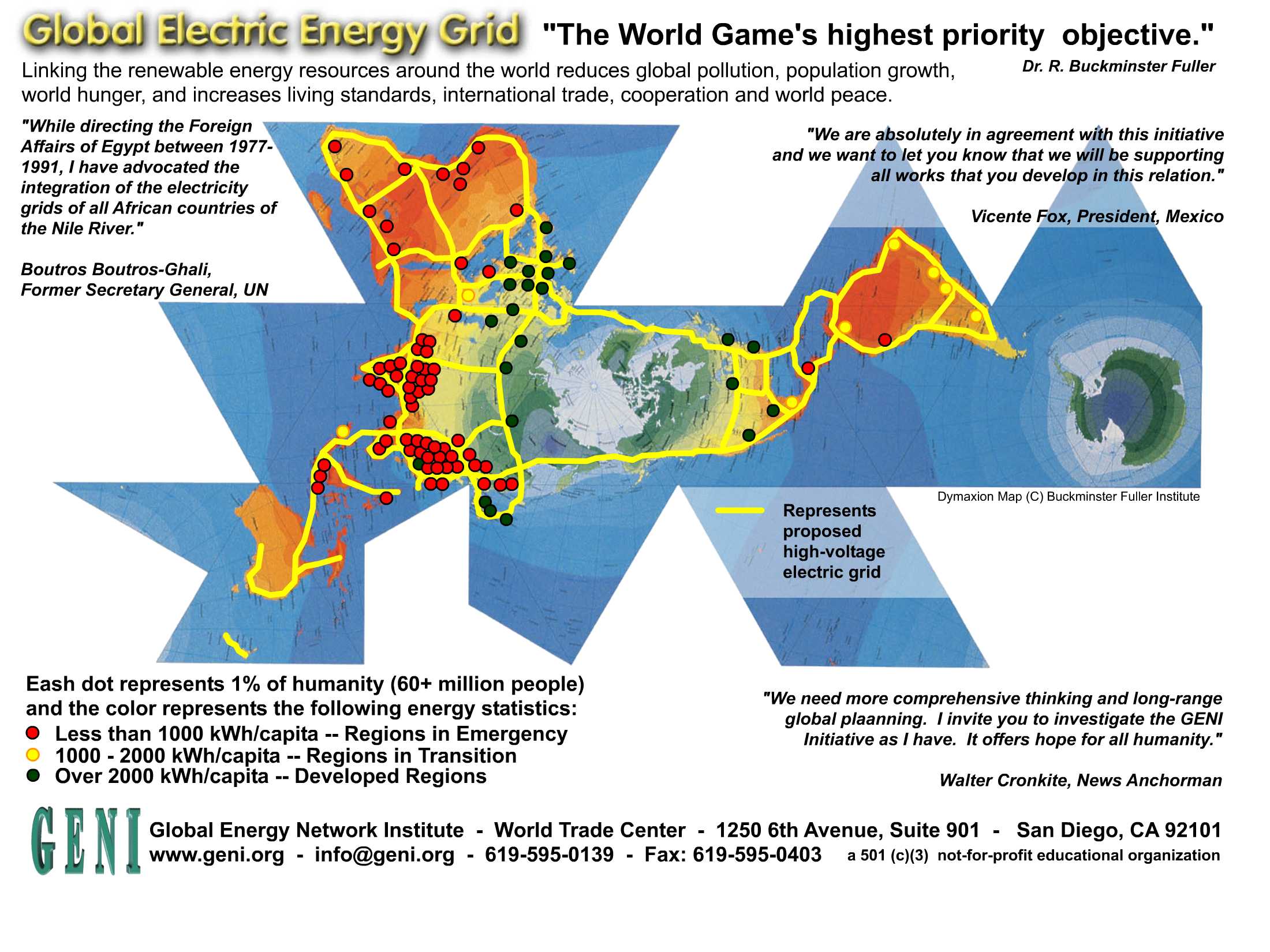
I just read MIT alum Peter Huber's piece on Oil, Gas and Wires in the latest Forbes where he makes the case for creating a high-voltage, continent-spanning and unified US national electric grid. This $75 Billion investment in infrastructure would unleash market forces in the power sector, enabling new generation sources, more competition and lower prices for electricity, and encourage many liquid fuels users to electrify. As MIT's Tech Review spotlighted in an article on A Smarter Power Grid, the current US network is trifurcated...This got me interested in the more general question of whether interconnecting into a global electric grid was a logical extension of Huber's argument. This is what organizations such as GENI Global Energy Network Institute argue for (and which Bucky Fuller first suggested decades ago)... GENI also points out the growing number of regional international grids and cooked up this promo video to advocate the grid... While grid solutions do seem to make sense in general and under ideal conditions, it nevertheless seems like a lot of good will come from off-grid innovations -- whether it's bringing first-light to remote villages through solar or it's creating backups and alternatives to the all-to-frequently "flaky grid".
MIT $100K Entrepreneurship Competition, Enterprise Forum Global, Enterprise Forum of Cambridge, Muddy Charles Pub, African Business Club, Sloan Entrepreneurs for International Development, Global Startup Workshop, Sustainability@MIT, TechLink, Making Progress, HighTechFever.tv, MIT Innovation Tours