





Dive Into the Ghent Altarpiece
4 hours ago
" Singapore is one of the most densely populated cities in the world -- but it's also one of the most high-tech when it comes to green city planning. Now, other Asian cities are looking to Singapore for inspiration. [...] Chinese authorities are now beginning to take note and view Singapore as a model in terms of planning and sustainability. [...] Chinese all over the country have been to Singapore... they like what we've done in Singapore and they would like their cities to be developed like Singapore."
 Nice design by Singapore-MIT team for Sesame Ring, an RFID replacement for the Charlie Card to access public transit (and in principle, much more!) This "One Ring To (Ride) Them All" is now Kickstarting! (See also Jenny Xie's nice writeup in Atlantic Cities)
"...Singapore’s successful urbanizationThe ten principles are:
experience -- despite its population density, the city-state has consistently ranked favorably in various surveys measuring the liveability and sustainability of cities around the globe. [...] Each of the 10 principles in the publication reflects Singapore’s integrated model of planning and development, which weaves together the physical, economic, social and environmental aspects of urban living."

 I'm also impressed with the dual park+infrastructure waterway greening of Kallang River at Bishan-Ang Mo Kio Park...
  This reminds me of efforts in Los Angeles to revitalize and restore the LA River, Madrid's opening of their Rio, the Room for the River efforts in Netherlands and Europe, and most especially the Daylighting of Seoul's Cheonggyecheon.
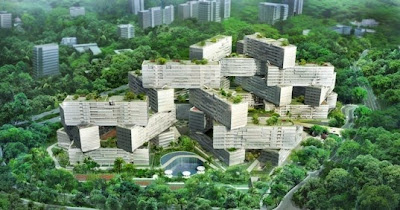
"With a growing number of people living and working in tall buildings, architects have become increasingly concerned with finding ways to introduce horizontal spaces -- providing a place for residents to socialise, exercise and get some fresh air. Sharanjit Leyl visited The Pinnacle@Duxton building in Singapore, a public housing complex of seven buildings linked with "sky bridges"

"Back in the 1960s and 1970s, the Massachusetts Institute of Technology was in the university-building business. [...] More than a generation later, MIT is at it again. [...] MIT is not stamping its name on campuses overseas. Instead it has seemed content to be a less-showy, largely silent partner in its international ventures. [...] these upstart institutions are being built in the spirit of MIT's motto, Mens et Manus, or Mind and Hand. They are meant to have real-world impact. [In the words of our new President...] "We cannot replicate MIT anywhere else," says Mr. Reif, a former provost and longtime faculty member. "It took us 150 years to get what we've got."It's a fascinating piece, missing as much as it reveals, including essential history and failures. But read the whole thing!


"The world’s biggest eco-city in development, Tianjin Eco-city will be around half the size of Manhattan. [...] Few things can be certain about the future, as philosophers wiser than I have pointed out, but one trend that is likely to continue is urbanisation. The Anthropocene will be populated by city dwellers, in contrast to the rural demography of the past millennia, and this has profound implications for human society. [...] The site chosen for the project was an industrial dumping ground for toxic waste, barren salt flats abutting one of the world's most polluted seas. This was deliberate, says Ho Tong Yen, head of Sino-Singapore Tianjin Eco-city Development and Investment, the firm charged with building the city. "In the past, so-called ecocities have been built in ecologically important areas or on useful arable land. We wanted to show that it's possible to clean up a polluted area and make it useful and liveable." [...] the city is setting itself up as a hub for green tech enterprise and creative industries. Six hundred companies have already set up shop, including an animation studio that is powered by its own energy station, incorporating solar PV walls as well as roof panels."


 Boston Public Garden...
 New York's Central Park...
 Hong Kong park...


"By 2025 Malaysia will have a brand new metropolis of three million people. But will tourists be tempted by what Iskandar has to offer? Several flagship projects are under construction, including luxury hotels, shopping centres and theme parks - all aimed at increasing investment in Malaysia."

"The development region encompasses an area about three times the size (2,217 sq km) of Singapore [...] Iskandar Malaysia is modelled after the Pearl River Delta Economic Zone, it is envisaged to capitalize on its current synergies with Singapore as it aims to complement each other as an economic hub."

 Given the word that Namibia has Angola-scale oil and gas deposits, it's worth taking another look at this most intriguing south-west-African country -- a state half the size of north American Alaska!
  In addition to capital city Windhoek and southern coastal port town Lüderitz, there's the north-central coastal Swakopmund and especially the nearby historical enclave of Walvis Bay...
 "...a haven for sea vessels because of its natural deepwater harbour, protected by the Pelican Point sand spit, being the only natural harbour of any size along the country's coast. Being rich in plankton and marine life, these waters also drew large numbers of whales attracting whalers and fishing vessels. The Dutch referred to it as Walvisch Baye and the English as Whale Bay. In its eventual proclamation it came to be called Walfish Bay, then Walvish Bay, and ultimately Walvis Bay. [...] During the scramble for Africa, the United Kingdom annexed Walvis Bay and a small area surrounding the territory in 1878 to the Cape Colony both to forestall German ambitions in the region and to ensure safe passage of British ships around the Cape. In 1910, Walvis Bay, as well as the Cape Colony, became part of the newly formed Union of South Africa. However, a dispute arose with Germany over the enclave's boundaries. This was eventually settled in 1911 and Walvis Bay was allocated an area of 434 square miles (1,124 km2). [...] In 1990 South-West Africa gained independence as Namibia but Walvis Bay remained under South African sovereignty. At midnight on 28 February 1994 sovereignty over Walvis Bay was formally transferred to Namibia."
 I'm fascinated by such historical enclaves. Other great examples include Hong Kong, Singapore, Monaco, Gibraltar, the Panama Canal Zone, and on the African continent, both Ceuta and Melilla in Morocco. Today, Walvis Bay is fully integrated into Namibia, itself a former German colony which today is a fascinating up-and-coming African country, part of the rapidly growing SADC economic community...


