

Super Intelligence, Indeed
3 hours ago
Exponential Innovations Everywhere
* * *
Joost Bonsen's Opinions on How Money, Ideas, and Talent can
Enable Health, Wealth, and Happyness for Each plus Achieve Liberty, Prosperity, and Vitality for All and Ultimately Help Us Spread Beyond Our Cradle Planet Earth
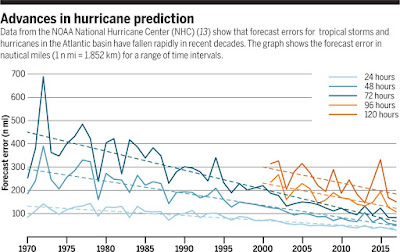
"In recent decades, advances in forecasting have been rapid, arising from improved observations and models, and better integration of these through data assimilation and related techniques. Investment in weather forecasting pays large dividends, ranging from 3 to 10 times the costs. [But] the developing world is especially vulnerable to weather disasters yet is underserved by forecasting."
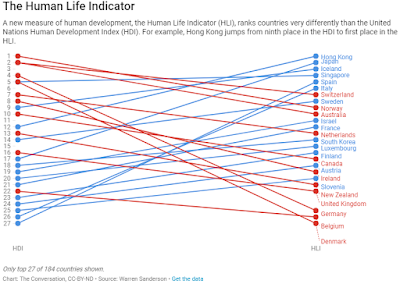
"The HDI is like a country’s report card. In a single number, it tells policymakers and citizens how well a country is doing. The HDI has been wildly successful in changing the way people think about the development process. However, it still suffers from real flaws. First, it implicitly assumes trade-offs between its components. The HDI also struggles with the accuracy and meaningfulness of the underlying data. Finally, data on different domains may be highly correlated. The HLI looks at life expectancy at birth, but also takes the inequality in longevity into account. If two countries had the same life expectancy, the country with the higher rate of infant and child deaths would have a lower HLI."

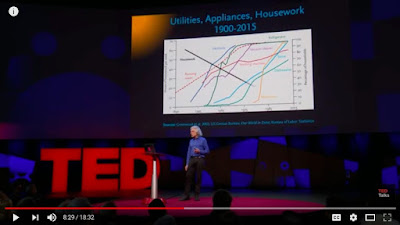
"We will never have a perfect world, and it would be dangerous to seek one," he says. "But there's no limit to the betterments we can attain if we continue to apply knowledge to enhance human flourishing."

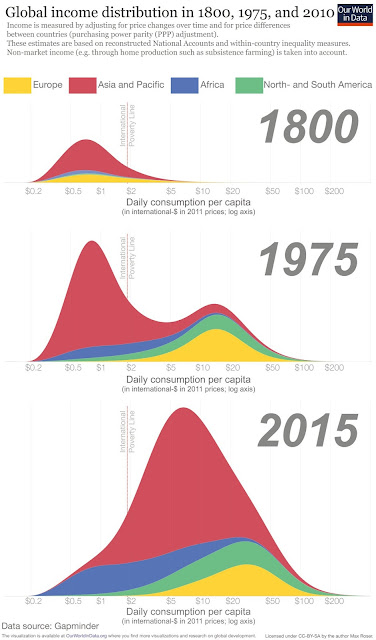
"There are three takeaways from this data. The first conclusion [...] is that the world is getting richer. Hundreds of millions of people have been lifted out of extreme poverty. That’s wonderful news. The second conclusion, as seen by the red section of the chart, is that a modest bit of reform in India and China has paid big dividends (and, given the success of Indian-Americans and Chinese-Americans, I imagine those nations could become much richer with additional market-friendly reform). But I want to focus today on a third conclusion, which is that pro-growth policies are the best way to help the poor, not redistribution driven by a fixation on inequality."
"We only enter the future on the intellectual capital brought to this world by the geekosphere!"
 The BBC's Richard Taylor reports in the Next Silicon Valleys series that Boston breaks through: Speed reading and life-size robots making a lot of noise over the supposed east vs west coast rivalry...
 "What grates here is that Mark Zuckerberg famously started Facebook from his Harvard dorm room, but before long took the social network to the other side of the country [...] all too often Boston start-ups end up being snapped up by their bigger, West Coast brethren; witness Google's recent purchase of another local robotic success story, Boston Dynamics. The challenge for Boston, it seems, is not just to develop the talent, but to hold on to it too."Sorry, what most grates is that Taylor entirely missed the real story which is that Boston has intentionally been exporting innovation -- i.e. successfully distributing the enabling pieces, processes, and philosophy of progress and prosperity -- for over a century. MIT people, for instance, went out to co-found Stanford University and then later Stanford's Research Park, Hewlett-Packard, Watkins-Johnson, Shockley Semiconductor, Fairchild Semi, Intel, Kleiner-Perkins, and dozens more essential elements which actually made Silicon Valley possible in the first place. The problems of our planet are too many for us to be geographically parochial and not spread the innovation ethos everywhere.
 Thanks to PD Smith for reviewing The New York Nobody Knows by William B Helmreich in the Guardian...
 "Sociologist William B Helmreich was born and grew up in New York City. As a boy, he and his father played a game called "Last Stop". It involved riding the subway from the station at 103rd Street near their Upper West Side apartment to the last stop on the line. Then, like intrepid explorers, they would discover the area's secrets on foot. (Helmreich's father died in 2011 at the age of 101.) In a sense, this book is a continuation of that urban game. To write The New York Nobody Knows, Helmreich walked 6,048 miles, covering almost every block in the city's five boroughs: Queens, Manhattan, Staten Island, Brooklyn and the Bronx. It took him four years, walking an average of 1,512 miles a year. He wore out nine pairs of shoes. Helmreich admits that "you have to be a little crazy to explore the city as I did". But big cities do that to you. [...] It's refreshing to read a book that celebrates so unreservedly the ethnic diversity of a city and entirely fitting that it should be about a metropolis that has always been defined by its cosmopolitan culture. For Helmreich, the city's diversity is the well-spring of its success."Be sure to also check out PD Smith's own book, City: A Guidebook for the Urban Age.
"Many years ago, a little girl was rushed to a rural county hospital from summer camp for an emergency appendectomy. As a teenager, she received antibiotics for a bad case of pneumonia. When she grew up and was about to deliver her first child, fetal monitors indicated that the baby’s heart rate had slowed, and a Cesarian section was performed urgently. In middle age, she underwent laparoscopic repair of an injured knee. The little girl, the teenager, the young mother, the middle aged woman, was -- is -- me. My medical history isn’t remarkable -- and that’s the point. Like most people alive today, I’ve been the fortunate recipient of treatments now so routine that we take for granted they haven’t always been available. Yet, a century ago, or even less, I could easily have died at summer camp or succumbed to pneumonia; my baby and I might not have lived through that pregnancy; and if I had survived to middle age, I would have done so limping and in pain."And that is simply epic, not a miracle at all but the glorious consequence of technological progress and human rationality applied to healthcare.
 Andrew Pollack writes in the NYTimes that Genetically Altered Salmon Get Closer to the Table about AquaBounty's GM super-fish which...
 "...contains a growth hormone gene from a Chinook salmon as well as a genetic on-switch from the ocean pout, a distant relative of the salmon. Normally, salmon do not make growth hormone in cold weather. But the pout’s on-switch keeps production of the hormone going year round. The result is salmon that can grow to market size in 16 to 18 months instead of three years."It still needs FDA approval, but as you can imagine, luddites and religious wingnuts of all flavors are already protesting noisily. P.S. Pollack writes on 21 Dec 2012 that Engineered Fish Moves a Step Closer to Approval...
"The Food and Drug Administration said it had concluded that the salmon would have “no significant impact” on the environment. The agency also said the salmon was “as safe as food from conventional Atlantic salmon.” While the agency’s draft environmental assessment will be open to public comment for 60 days, it seems likely that the salmon will be approved, though that could still be months away."


