12 April 2008

Nexi Robot
Watch Neri Oxman voice Nexi, the mobile dextrous social robot out of MIT Media Lab professor Cynthia Breazeal's Personal Robotics group...
11 April 2008
Bridging the Green Line ~ Cyprus Resurgent!
 Fantastic to read today on BBC in an article entitled Symbolic Cyprus border crossing that Turkish Cypriot leader Mehmet Ali Talat took an spontaneous stroll across the Green Line in capital city Nicosia into Greek Cypriot territory. He walked along the main drag, Ledra Street purchasing a few morsels and chatted with locals!
10 April 2008
Pressing Need for Rail Infrastructure Upgrade in Africa...
 In an International Herald Tribune article entitled Train to (almost) nowhere in Mauritania the caption for this photo is...
 Passengers rushing to board an ore train in Nouadhibou. The journey to Zouérate in remote northwest Mauritania takes 17 hours. (Candace Feit for The New York Times)There's got to be a better way, perhaps separating the operations of the railway from the ownership of the rails and the mines, thus giving the operator incentive to provide proper passenger & small-freight service and generally dial-up the rail infrastructure. This is a specific situation in Mauritania, but is generalizable to dozens of countries and even more transit corridors.
MIT Energy Showcase ~ Friday 11 April 2008
 Definitely check out this Friday's MIT Energy Showcase 2008 with nearly 100 companies, labs, and other key players in the greater MIT energy tech venture zone!
Anjuli Gupta of CircleCapital on HighTechFever
I hosted Anjuli Gupta -- MIT Sloan MBA Second Year student and Co-Founder of CircleCapital -- on my HighTechFever TV show tonight. CircleCapital is a microfinancial services ventures connecting savings banks to the several million employees who are most-trusted by the well-to-do employers in major Indian conurbations.
09 April 2008
See-the-forest of Intellectual Property
I'm sitting now with both Jaime Mateus and Joe Hadzima at the MIT Muddy Charles Pub about intellectual property. And Joe showed us the latest incarnation of his IPVision web presence, See-The-Forest, the Intellectual Property Patent Analytics site. Free. Stunningly cool. Do your own search...
MIT in Ghana ~ Pure Home Water
 MIT's David Chandler wrote another great MIT in the World article entitled What is good water worth? about MIT Senior Lecturer Susan Murcott's Pure Home Water venture, which sells simple, low-cost ceramic water filtration systems to people in northern Ghana. This was a joint Civil & Environmental Engineering / MIT Sloan School student-project, including a G-Lab team.
08 April 2008

Beehive School in Malawi ~ ICT4D Update!
 I just met with Justin Cannon of the MIT ICT4D class Beehive Project. He just returned from a Spring Break trip to Malawi where he visited the Beehive School, a five-year old elementary school with over 150 students in Mzuzu, Malawi. It's a fascinating and very promising school, with a strong academic core and very student-centric. Justin's project includes escalating their PC and ICT teaching capacity. What's also interesting about the Beehive School is that a couple generations of MIT students have helped them escalate, including Justin and previously Eva Markiewicz & Spencer Ahrens. The prime ambition of Naill Dorey, the founder and Headmaster, is to expand the facility, add more teachers, and to begin teaching teachers. I hope that he further aspires to replicate the Beehive School network throughout Malawi and the region.
Participatory Citizen Science ~ Project BudBurst
 Nice article in today's USAToday entitled 'Citizen scientists' record warming data about Project BudBurst, a field campaign engaging citizen scientists in tracking the dates that dozens of plant species sprout leaves and flowers this spring and summer. This is participatory wikiscience, a very compelling movement indeed, something we've been incubating at both MIT and Harvard!
Affordable is Beautiful ~ Polak on Getting People "Out of Poverty"
 I bought it, for $20 cash, from MIT's part-time bookseller Amy Smith after today's Technology & Culture Forum / D-Lab talk (a rare opportunity to see Amy in a mercenary mode;-) And now, editorial: Paul Polak's Out of Poverty is perhaps one of the most important books I've ever read. Polak spells out facts and offers analyses and argues for solutions -- affordably cheap, of course -- which transform the lives of dollar-a-day rural farmers and slum-dweller laborers. I'm more optimistic now than ever, because he's even further convinced me that the billion daily-dollar poor are, in fact, a giga-opportunity for those who truly get that Affordable is Beautiful and offer products or services accordingly.
07 April 2008
Paul Polak of IDE ~ Is Charity Ethical?
 International Development Enterprises (IDE) founder Paul Polak spoke this Monday night about his development experiences in a talk entitled Is Charity Ethical? (unlike the publicized title What Are Ethical Development Practices?)
Interesting, even provocative, and often contrarian quotes (not in original order, hence "quotes"):
"If everything's free, it encourages immorality." "Charitable development and subsidies usually do more harm than good." "I prefer to go with market-forces." "Many people don't agree with me. Jeff Sachs for instance." "Better to help people to earn income so they can afford health care." "Affordability isn't everything, it's the only thing." "If you haven't talked to 25 poor people before starting, if it can't pay for itself in the first year, and if you can't sell at least a million of them -- Don't Bother!" "With business as usual, the Millennium Goals on hunger and poverty will never be reached!" "Four revolutions are needed to end poverty: Water, Agriculture, Design, Markets." "Small farmer prosperity is single most important thing to ending poverty." "This is key to bringing earth into balance. If get people out of poverty, then global population will stabilize at lower number." "We need a revolution in how we think and act about poverty before we can end it." "I wrote the book to help create the revolution to end poverty." "I started a new company Design Revolution trying to make obscene profits serving global customers."
He's written a book about his experiences called Out of Poverty: What Works When Traditional Approaches Fail.
FYI, here's a video of Paul about Practical Problem Solving...
Inspiring Modern Engineers...
Nice guest column in today's Boston Globe by MIT President Susan Hockfield entitled MIT's burgeoning role in the green movement. She writes about both global challenges (and what MIT is doing about them)...
The challenges are many. How do we meet the aspirations of people around the world for a healthy, comfortable, productive life, without irreparably damaging the planet? How will we in the developed world preserve our quality of life, while shifting to renewable technologies? At the same time, how do we enable the developing world to reach a standard of living that grants access to modern comforts? How, for example, will we get electricity to the 1 billion people who don't yet have it?She concludes with an appeal to new generations of innovators...
We need to help more young people see these problems as theirs, and to feel in these great challenges the kind of inspiration my generation experienced in the race to the moon - the kind of inspiration that made science and engineering feel exciting and important, that made us believe that the sky was no longer the limit; the kind of inspiration that will spur young people today to reach for the sun.I very much hope this appeals to up-and-coming high school students so MIT's new admissions Dean Stu Schmill can admit them!
Learning from The Ancient Engineers
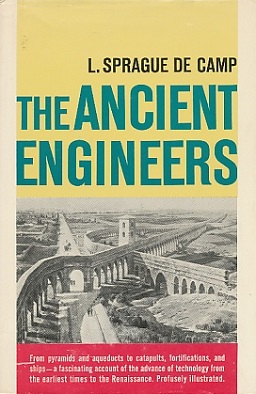 I stumbled across a really wonderful book, L. Sprague de Camp's The Ancient Engineers (partially available online at the Amazon Online Reader). de Camp's better known as a writer of Science Fiction -- a contemporary of Asimov & Heinlein -- but this survey of historical engineering and engineers is both educational and inspiring. Just a few passages...
 Civilization, as we know it today, owes its existence to the engineers [...] who, down the long centuries, have learned to exploit the properties of matter and the sources of power for the benefit of mankind. By an organized, rational effort to use the material world around them, engineers devised the myriad comforts and conveniences that mark the difference between our lives and those of our forefathers thousands of years ago. [...]
Invention has been going on ever since our apish ancestors learned to feed a fire and flake a flint. But the conditions under which invention takes place, and the pace of invention, have changed greatly since the beginning of historic times. [...] Progress in civilization depends upon invention, and a rapid rate of invention in turn depends upon the sizable populations that are only possible under civilization. The crucial inventions that made such progress possible -- knowledge of raising domesticated, edible animals and plants -- took place in Syria and Iraq about [10,000 years ago].
The rest of the book showcases inventions and engineered artifacts -- large and small -- worldwide up to the Industrial Revolution. Fantastic stuff!
If only books like this were the summer reading for the newly admitted and arriving MIT students...
06 April 2008
Kirsner Misses MIT's Compton et al...
 Scott Kirsner did a nice review in his Innovation Economy column in today's Sunday Globe entitled Venture Capital's Grandfather of the Creative Capital book about Georges Doriot and American Research & Development or AR&D, the first formal venture capital fund. But he misses the crucial role played by MIT President Karl Compton and the other Bostonian co-founders of AR&D, including other MIT faculty and alums active in local financial circles. Doriot was an amazing manager and operator of the fund, but the others had the creative vision to initiate it, inspired by the tremendous fruits of WWII war-research and imagining the civilian applications, but realizing there needed to be proper financing to bridge the transition. In any case, check out Scott's video of an entrepreneur who engaged with "The General" online at Innovation Economy
MIT in Transition ~ A Student Advisory Report Worth Revisiting...
 It's worth revisiting the MIT in Transition: Student Perspectives on MIT's Legacy Strengths, Emerging Challenges, and Future Directions report I co-authored with Barun Singh & Harel Williams (and other Student Advisory Board members). We tried to urge bold new thinking on the part of MIT senior leadership (including transforming that leadership towards greater competence). What's striking to me is that so much of what we as students could see as areas for urgent action have been largely ignored. I am disappointed and would hope that an Institute of MIT's caliber could dial it up dramatically.
Subscribe to:
Posts (Atom)


