 Catching up on my reading, I discovered a most interesting FT interview, entitled Nothing Ventured by Michael Skapinker, of private equity investor Sir Ronald Cohen. Key quotes: "Business investment can act as a force for peace in the Middle East." "...encouraging enterprise in deprived areas [...] for regeneration projects." "Politicians are generally skeptical about the importance of economics in peacemaking [...] but Northern Ireland show that if you concentrate on business, peace will follow." And more. The interview spotlights Cohen's foundation, The Portland Trust for promoting peace and stability between Palestinians and Israelis through economic development, and two investment initiatives in particular, a $1 Billion housing project in the West Bank, and a $300 Million Palestinian loan guarantee program.
25 April 2008
Business Investment as Force for Peace in Middle East
Catching up on my reading, I discovered a most interesting FT interview, entitled Nothing Ventured by Michael Skapinker, of private equity investor Sir Ronald Cohen. Key quotes: "Business investment can act as a force for peace in the Middle East." "...encouraging enterprise in deprived areas [...] for regeneration projects." "Politicians are generally skeptical about the importance of economics in peacemaking [...] but Northern Ireland show that if you concentrate on business, peace will follow." And more. The interview spotlights Cohen's foundation, The Portland Trust for promoting peace and stability between Palestinians and Israelis through economic development, and two investment initiatives in particular, a $1 Billion housing project in the West Bank, and a $300 Million Palestinian loan guarantee program.

Mega-Regions ~ Economic & Innovation Hubs
A couple weeks ago, the Wall Street Journal published an OpEd piece by Professor Richard Florida, director of the Martin Prosperity Institute at Toronto's Rotman School of Management, entitled The Rise of the Mega-Region. Florida spotlights the dramatic and disporportionate importance of the 40 mega-regions powering some two-thirds of global economic output and innovative production. Fascinating stuff. Also worth looking at is Florida's earlier work seeking to understand the Creative Class and what attracts and inspires such folks. His latest book is Who's Your City, which he spoke about at Google... And here's an example map from his website, in this case, the density of Creative Class people in the US...  And this map of US Mega-Regions...
  And finally this humorous map of Singles!
And this map of US Mega-Regions... And finally this humorous map of Singles!
Update ~ Floating Power Plants
 I wrote about Floating Power Plants a while ago. And indeed, given the power crisis in South Africa and beyond, as documented by the Wall St Journal in an article entitled In Africa, Outages Stifle a Boom, there's a timely Waller Marine update article entitled Are Non-Nuclear Floating Power Plants an Option for South Africa? Also, TR spotlights the promise of floating windpower in an article entitled Wind Power That Floats: Advances in floating platforms could take wind farms far from coasts, reducing costs and skirting controversy. They note several examples, including the Blue H deepwater windpower floatsystem.
Dissecting the Livescribe!
 MIT's Technology Review magazine has a nice take-apart dissection of the Livescribe...
 ...a computerized pen that records as you write and digitally syncs the audio recording to the notes. Write or draw on specially patterned paper; then tap the pen on a word or sketch, and it will play back what was being said when you made those marks. The pen can also solve equations and define or translate words.
MIT as Microcosm ~ Energy is Not Enough...
As ardent readers of Maximizing Progress know -- from having read either my Imagining MIT piece, or my personal MIT 2020 story -- I'm one of those at the Institute who are interested in having our campus be a predictive microcosm of what the world might become in the future -- i.e. green, clean, efficient, effective, beautiful, amazing. But getting there soon -- or even launching an initiative to raise the money -- means educating and inspiring people and rallying folks around big ideas and common goals. Towards that end, I wrote a small missive to our organizing team pleading with them to embrace a bigger vision. Right now everything is very energy-centric, with some folks pushing to be under the umbrella of the MIT Energy Initiative. I argued that "Energy is not enough..."
With all due respect to Energy Initiative folks and our Walk The Talk leadership, I think Energy alone is NOT enough for even our initial efforts.
This is not merely a quibble over selecting our top short-term tactics, but a matter of core strategies and overarching vision.
I deeply believe the Institute needs a much broader -- and more inspiring -- action agenda. We ought to aspire towards Regeneration & Vitality in the large. This means embracing economic renewal, environmental sustainability, worthy aesthetics, and transformative innovations in physical infrastructure, operational excellence, institutional leadership, and beyond.
If we at MIT can't get our own house in order by 2015-2020 (or sooner), what moral standing do we have for advising others, and what hope do we have for our planet more generally?
Indeed, the MIT of 2020 should be a microcosm of what we want our civilization to become. Using our campus-as-testbed would allow us to see the future first. Plus using our campus as exploratory learning-lab both lives up to our Mens et Manus motto and educates and inspires new generations of innovators. We urgently need to ramp-up our efforts to do this not merely in Energy, but across many different dimensions, including at least:We need to BE how we want the world to BECOME. Aspiring to anything less means becoming irrelevant.
- Aesthetics -- The MIT campus could use an intense aesthetic upgrade, with greenways, widewalks, bike lanes, underground parking, greenroofs, indoor foliage, informal cafe-style seating, proper maintenance, essential repairs, and more. The best of these initiatives would offer two-for-one. For instance, attractive roofgarden cafes would also boost our LEED qualities. It is inexcusable that MIT today owns and just land-banks ugly surface parking lots in the heart of Kendall Square, along Amherst Street, and along the premier pedestrian and urban thoroughfare of Mass Ave.
- Environmental -- In addition to pure aesthetics, many of the tangible aspects of campus energy are predominantly environmental in nature, for instance, localized air temperature control, fresh-air access, insulated entry-doors and windows, wide-spread recycling, waste minimization initiatives, emissions remediation, garbage handling, transportation solutions, and more.
- Information Technology -- Lots of new energy ideas would benefit from MIT having a campus-wide Project Athena Version 2.0, this time a distributed mobile-wireless network enabling sensors and distributed information mining, and most important, the feeding forward of essential info to users via mobile phones and other highly distributed end-points. We could mine social patterns of energy-use and transport behavior and fast-iterate accordingly.
- Economic -- Our near-neighborhood is too much of an economic monoculture of bland office parks and corporate labs. Those are certainly essential, but alone insufficient. We need to extend the mixed-use aspects of University Park to pervade greater-Kendall Square, the Mass Ave axis from MIT-through-Central, and the edges of the Institute along Main, Vassar, Portland, and Albany. This means ground-floor retail, a mix of residences and offices, and orchestrating a few investments in conference facilities, entrepreneurial incubators, and university coop residences. (Plus the aesthetic improvements noted earlier).
- Organizational -- Many of the underlying challenges here are actually driven by the Institute's loosely-coupled organizational form. This structure works wonders in allowing for distributed innovation and fast-action at small-scales, but can impede bold cross-connections and big moves. If our institutional leadership neither gets this nor understands how to both weave together an integrative vision and inspire people to rally around it, then we will continue to remain stuck where we are -- more muddling. In this regard, MIT is yet again a microcosm of the nation and world at-large.
Devil's Pool @ Victoria Falls ;-)
 Remarkable natural phenomenon: a slow-flow Devil's Pool at the lip of one of the world's most amazing waterfalls! Thrill-seeking daredevils hang at or even over the edge. (Btw, Victoria Falls is just one of the hundreds of natural resources and tourist attractions that Zimbabwe has to offer. That country should be one of the richest in Africa, and, I hope, soon will be if Zimbabweans themselves act in concert for positive change. As I've written before, the world can help but not lead in this effort.)
24 April 2008
MIT West Africa Networking Reception 2008
 I'm delighted to report that the MIT Sloan Trip to Ghana was a success and especially that the first-ever MIT West Africa Networking Reception went outstandingly well, connecting current and potential students, alums and friends together in a wonderful Accra, Ghana venue. This is one of a growing series of global development efforts -- and especially West African initiatives -- I've helped finance and co-orchestrate. Kudos also to the MIT Sloan Africa Business Club for spotlighting the economic and entrepreneurial promise of Africa.
Amazing Feat of Human Strength & Balance ;-)
Preposterous and amazing at the same time, a remarkable gymnastics-physiology tag-team demonstration...
Monetizing How-To DIY
 Nice article in the New York Times yesterday entitled Making Money, the How-To Way about "the rush to capitalize on the popularity of how-to videos on the Web." Couple links to popular videos too, including several ways to use sodabottles, something we at Howtoons especially care about!
23 April 2008
Anne Swift of Young Inventors on HighTechFever (Repeat)
 I re-introduced an interview with Anne Swift, founder and president of Young Inventors, on my HighTechFever TV show today. A little while ago she wrote an Xconomy.com article entitled Universities: An Entrepreneur’s Ecosystem discussing...
 Universities offer a thriving ecosystem that lends itself particularly well to entrepreneurship among students, faculty, and staff. My belief in the ability of the institution of higher education to foster entrepreneurship comes first hand from my experiences as a student entrepreneur at the University of Toronto, as well as my work with Young Inventors International, a non-profit organization that has taught hundreds of student entrepreneurs at universities across North America about innovation and bringing new products to market.
Martin Fisher / KickStart ~ MIT-Lemelson Inventor Awardee
 It's most excellent to see that Martin Fisher, co-founder of KickStart, a developmental entrepreneurship venture, is winner of the MIT-Lemelson Award for Sustainability 2008! Martin and colleagues produced and shipped hundreds of thousands of my favorite African brand, the Moneymaker Pump! From the press release...
 Dr. Martin Fisher is transforming the lives of thousands of poor African farmers through a combination of technological invention and system-wide business development. In collaboration with his co-workers, Fisher, the 2008 recipient of the Lemelson-MIT Award for Sustainability, has already enabled over 310,000 people to rise out of poverty.
Fisher will accept his award and present his accomplishments to the public at the Massachusetts Institute of Technology during the second-annual EurekaFest, a multi-day celebration of the inventive spirit, June 25-28, presented by the Lemelson-MIT Program.
22 April 2008
The "In Club" @ MIT
 Excellent Green Issue this past weekend in the New York Times Magazine. They mentioned the MIT Energy Club (and MIT Muddy Charles Pub) in a mini-article entitled The IN Club at M.I.T. Key club leaders Daniel Enderton and Lara Pierpoint were quoted discussing various events including the recent MIT Energy Conference (Version 3.0) and the MIT EnergyNights (co-created by yours truly and energy rockstar venture capitalist Dave Danielson, founder of the MIT Energy Club).
Robot Revolutionaries!
 I'm sitting right now with MIT Media Lab alumnus roboticist Cory Kidd at the MIT Muddy Charles Pub. Cory's visiting from Hong Kong where he and partner Erica have founded Intuitive Automata to commercialize Cory's weight loss coachbot, Autom. His work was also just mentioned in a US News & World Report in an article entitled The Robot Revolution May Finally Be Here. The article showcases a couple MIT spinoff companies, iRobot and Myomo. Very cool!
GDP per Capita ~ Measure of Progress
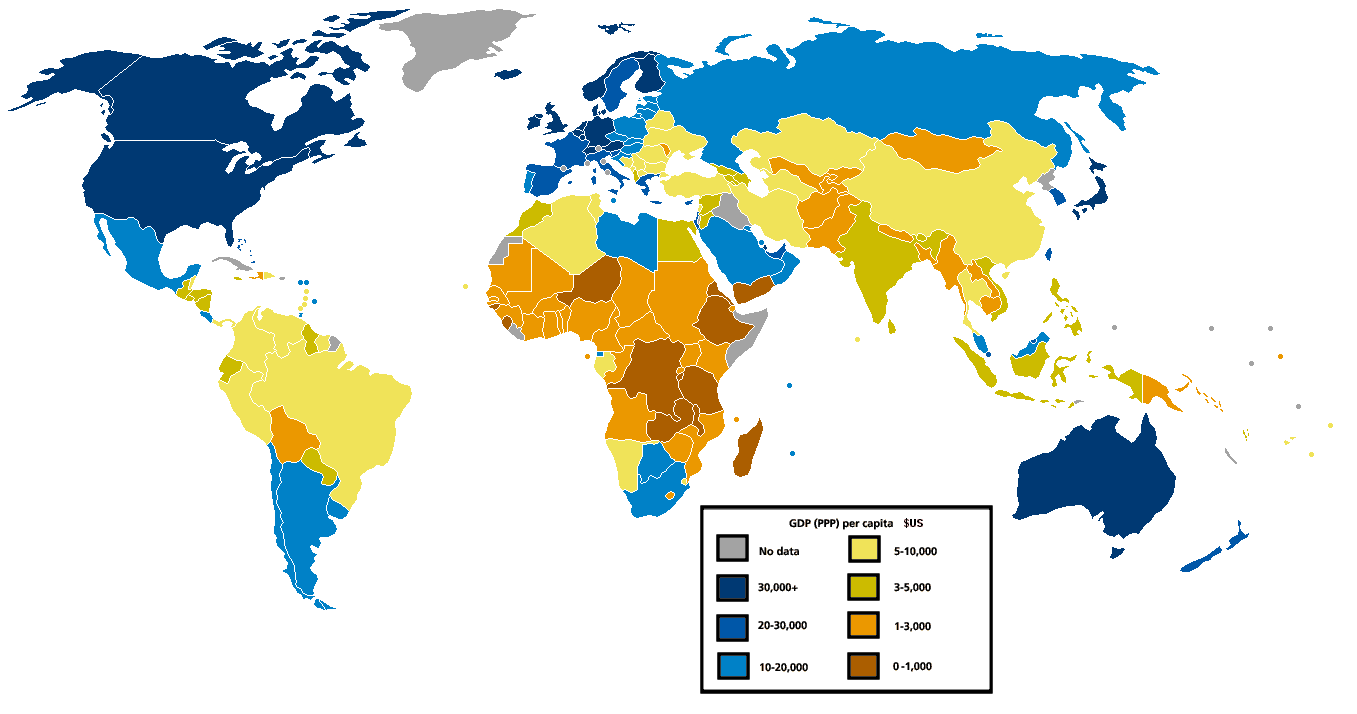
My MIT entrepreneur friend Manish Bhardwaj just pointed out this nice Economist piece entitled Grossly distorted picture: If you look at GDP per head, the world is a different—and, by and large, a better—place. "Using growth in GDP per head rather than crude GDP growth reveals a strikingly different picture of other countries' economic health" as you can see in comparative chart... 
21 April 2008

African Economic Promise
In an article entitled African economies: Lion cubs?, the Economist casts "an up-beat assessment of Africa. FOR those used to thinking of Africa as a fiscal bucket with a hole in it, a new IMF report on the continent makes for a heartening read."
Visualizing Economics!
I've been thinking a lot about economic convergence, or the Catch-Up Effect, where poorer countries have historically -- and potentially could in the future -- grow faster such that their GDP/capita converges with that of richer countries. Surprisingly difficult to find good visualizations about this phenomena, but here's one I found earlier from The Futurist...  While surfing about, though, I ran across the Visualizing Economics site run by Catherine Mulbrandon, an interaction designer. Some quite cool stuff posted there to help us grok economic essentials at a glance. Just as one tasty example, check out this chart comparing geographic origins or share of global GDP...
While surfing about, though, I ran across the Visualizing Economics site run by Catherine Mulbrandon, an interaction designer. Some quite cool stuff posted there to help us grok economic essentials at a glance. Just as one tasty example, check out this chart comparing geographic origins or share of global GDP...
20 April 2008
Old Enough to Vote... and Drink?!
 This week's Economist in an article entitled Drinking -- Too young to have fun: Is it time to lower America's drinking age? spotlights one of the most glaring examples of unconstitutional legislation in the US today, that of drinking age laws prohibiting 18-21 year olds from imbibing. In a crazy MADD extortionist social policy experiment in the 1980's, young voting-age citizens were systematically prohibited from drinking. Whereas Prohibition in the 1920's required a constitutional amendment, one ultimately overturned in an admission of futility by Repeal in the 1930's (another constitutional amendment), today's insidious and unfair and age-discriminatory laws have no worthy legal standing. And they're finally being attacked by a thoughtful coalition of ex-University Presidents, legal scholars, and outraged citizens. One entity spearheading change is Choose Responsibility, founded by John McCardell, the former president of Middlebury College in Vermont, who is leading the effort to lower the drinking age to 18. Again. Just to emphasize how anti-liberty and backwards the US is in this regard, check out the drinkingmap showing the legal drinking age by country...
19 April 2008


Subscribe to:
Posts (Atom)


