


Leftovers
2 hours ago
Exponential Innovations Everywhere
* * *
Joost Bonsen's Opinions on How Money, Ideas, and Talent can
Enable Health, Wealth, and Happyness for Each plus Achieve Liberty, Prosperity, and Vitality for All and Ultimately Help Us Spread Beyond Our Cradle Planet Earth
"The GlobalHealth Lab gives students a unique opportunity to work on the front lines of health delivery on-site in Sub-Saharan Africa and Asia, cumulatively over 50+ Projects in 13 Countries since 2008 with more than 40 host organizations, including clinics, hospitals, startups and non-profits."
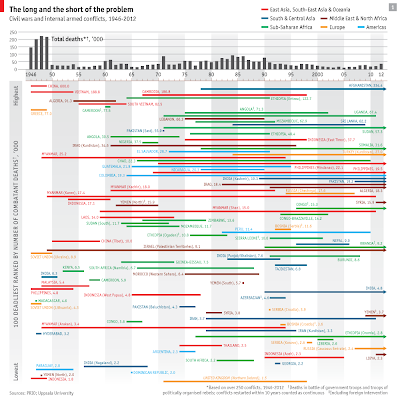
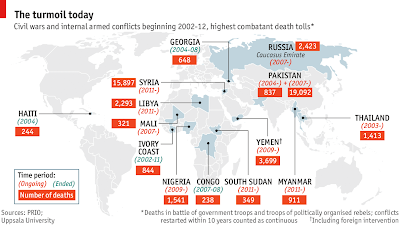 The Economist reveals about Civil Wars, How to stop the fighting, sometimes...
"Ending civil wars is hard. Hatreds within countries often run far deeper than between them. The fighting rarely sticks to battlefields, as it can do between states. Civilians are rarely spared. And there are no borders to fall back behind. [...] Yet civil wars do end. Of 150 large intrastate wars since 1945 fewer than ten are ongoing. Angola, Chad, Sri Lanka and other places long known for bloodletting are now at peace, though hardly democratic. And recently civil wars have been ending sooner. [...] So far, nothing has done more to end the world’s hot little wars than winding up its big cold one. [...] More conflicts ended in the 15 years after the fall of the Berlin Wall than in the preceding half-century [...] Until 1989, victory for one side was common (58%). Nowadays victories are much rarer (13%), though not unknown [...] The main reason for jaw-jaw outpacing war-war is a change in the nature of outside involvement. In the Cold War neither of the superpowers was keen to back down; both would frequently fund their faction for as long as it took. Today outside backers are less likely to have the resources for such commitment. And in many cases, outsiders are taking an active interest in stopping civil wars. [But] the motives vary."
 National Geographic has compelling infographic illustrating the Hazardous Habitat for urban cougars in Los Angeles to complement the feature story on Ghost Cats...
"Cougars are now the most common apex predator across one-third of the lower 48 states. Most of the other two-thirds lack any big predatory mammal. So far, anyway, a large cat whose trademark is stealth appears to be the major carnivore modern society finds easiest to accept, or at least tolerate. But people still want a clearer understanding of potential problems."

"It will become possible this century to upload your mind into a computer [thru] radical life extension and future technology that might change the human condition"
 The Guardian just published an edited extract from Happy City: Transforming Our Lives Through Urban Design by Charles Montgomery titled The secrets of the world's happiest cities asking...
"What makes a city a great place to live -- your commute, property prices or good conversation? [...] Is urban design really powerful enough to make or break happiness? The question deserves consideration, because the happy city message is taking root around the world. "The most dynamic economies of the 20th century produced the most miserable cities of all [...] totally dominated by cars." [...] By spending resources and designing cities in a way that values everyone's experience, we can make cities that help us all get stronger, more resilient, more connected, more active and more free. We just have to decide who our cities are for. And we have to believe that they can change. "
"We face huge challenges in terms of food, resources and climate change but at the heart of Rosling’s statistical tour-de-force is the message that the world of tomorrow is a much better place than we might imagine. Professor Rosling reveals that the global challenge of rapid population growth, the so-called population explosion, has already been overcome. In just 50 years the average number of children born per woman has plummeted from 5 to just 2.5 and is still falling fast. This means that in a few generations’ time, world population growth will level off completely. And in what Rosling calls his ‘Great British Ignorance Survey’ he discovers that people’s perceptions of the world often seem decades out of date."Here's mini-trailer/promo from BBC... And here's the main event!

"Once upon a time, in almost every city, many rivers flowed. Why did they disappear? How? And could we see them again? This documentary tries to find answers by meeting visionary urban thinkers, activists and artists from around the world."
"For 32km (almost 20 miles) the tracks of Petite Ceinture snake through bustling Paris, isolated and largely unseen from street level in deep trenches, long tunnels, and bridges. Nature has reclaimed the space and it has become a haven for wild flowers and animals. The line is officially off-limits to the public, but this hasn't stopped many people attempting to explore it. There is now a fierce debate in the French capital about what to do with the tracks and stations of the Petite Ceinture that still remain."


